From National Public Radio:
A major decision on the way the U.S. government collects information about race and ethnicity through the census and other surveys was expected to be announced last week by the Trump administration.
But the White House's Office of Management and Budget, which sets standards for this type of data for all federal agencies, was silent on Friday, which OMB had said was the deadline for an announcement.
A spokesperson for OMB could not provide any information about the delay.
Under consideration by the White House are proposals introduced during the Obama administration that would fundamentally change how the government counts the Latino population. Another proposal would create a new checkbox on census forms and other federal surveys for people with roots in the Middle East or North Africa. If approved, the policy changes could have significant implications on the upcoming 2020 census, as well as legislative redistricting, civil rights laws and health statistics.
"[The delay] tells me the new administration has taken an interest in the possible changes ... and wants to way weigh in," says Terri Ann Lowenthal, a former staff director of the House oversight subcommittee for the census who now consults on census issues.
Showing posts with label Census Bureau. Show all posts
Monday, December 4, 2017
Tuesday, May 9, 2017
Census Director Quits Just As The Census Ramps Up
From the Huffington Post:
The director of the U.S. Census Bureau is resigning, the Commerce Department announced Tuesday, leaving the government’s lead statistical agency without a clear leader as the bureau ramps up for the massive decennial task of counting the entire U.S. population in 2020.
Census Bureau Director John Thompson’s announcement that he is leaving at the end of June comes less than a week after he testified on Capitol Hill, telling House appropriators that his agency would be able to carry out the Census effectively, despite a number of cost overruns and a lower budget than normal for this point in the 10-year planning cycle.
Normally as Census planning shifts from the seventh year of the decade to the eighth, the budget jumps dramatically. But Congress did not pass the Obama administration’s budget for 2017, leaving the bureau about $160 million short of its $1.61 billion request.
The director of the U.S. Census Bureau is resigning, the Commerce Department announced Tuesday, leaving the government’s lead statistical agency without a clear leader as the bureau ramps up for the massive decennial task of counting the entire U.S. population in 2020.
Census Bureau Director John Thompson’s announcement that he is leaving at the end of June comes less than a week after he testified on Capitol Hill, telling House appropriators that his agency would be able to carry out the Census effectively, despite a number of cost overruns and a lower budget than normal for this point in the 10-year planning cycle.
Normally as Census planning shifts from the seventh year of the decade to the eighth, the budget jumps dramatically. But Congress did not pass the Obama administration’s budget for 2017, leaving the bureau about $160 million short of its $1.61 billion request.
Wednesday, November 30, 2016
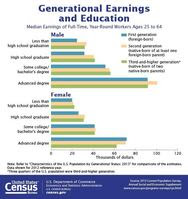
Children of Foreign-Born Parents More Likely to Be College-Educated Than Their Parents
|
Labels:
Census Bureau,
children,
colleges,
immigration
Tuesday, September 6, 2016
Census Retiring EasyStats
The Census is Retiring EasyStats. Below is information that maybe helpful for you as Census prepares to retire EasyStats.
• EasyStats will no longer be available on 9/30/16. http://www.census.gov/easystats/
• A notice to users was deployed on 8/16 as a pop-up. The notice states the retirement date and offers QuickFacts and AFF as alternatives.
• The notice on the application also features a feedback form for users to leave comments.
• The retirement of the application is a result of a CEDSCI data tools assessment from earlier this year. The assessment looked at consolidating data tools to eliminate redundancy and also streamline our data dissemination offerings on Census.gov.
• EasyStats will no longer be available on 9/30/16. http://www.census.gov/easystats/
• A notice to users was deployed on 8/16 as a pop-up. The notice states the retirement date and offers QuickFacts and AFF as alternatives.
• The notice on the application also features a feedback form for users to leave comments.
• The retirement of the application is a result of a CEDSCI data tools assessment from earlier this year. The assessment looked at consolidating data tools to eliminate redundancy and also streamline our data dissemination offerings on Census.gov.
Friday, August 26, 2016
County Business Patterns (CBP) website has moved
The County Business Patterns (CBP) website has migrated to a new link. The new link is http://www.census.gov/programs-surveys/cbp.html.
The old link will no longer work. If you have any old links to the website bookmarked, please update your bookmarks.
CBP is an annual series that provides subnational economic data by industry. This series includes the number of establishments, employment during the week of March 12, first quarter payroll, and annual payroll.
Please feel free to contact the Census Bureau by email at ewd.county.business.patterns@census.gov, or by phone at 301-763-2580 if you have any questions.
The old link will no longer work. If you have any old links to the website bookmarked, please update your bookmarks.
CBP is an annual series that provides subnational economic data by industry. This series includes the number of establishments, employment during the week of March 12, first quarter payroll, and annual payroll.
Please feel free to contact the Census Bureau by email at ewd.county.business.patterns@census.gov, or by phone at 301-763-2580 if you have any questions.
Monday, April 25, 2016
Older Americans Month: May 2016
President Kennedy first celebrated older Americans by designating May 1963 as Senior Citizens Month. After a meeting with the National Council of Senior Citizens, Kennedy encouraged all Americans to pay tribute to older people across the country. Every President since has issued a formal proclamation during or before the month of May in support of older Americans. In 1980, President Jimmy Carter’s proclamation changed the name to Older Americans Month. This month continues to be a time to celebrate those 65 and older through ceremonies, events and public recognition.
46.2 million
The number of people who were 65 and older in the United States on July 1, 2014. This group accounted for 14.5 percent of the total population. The 65 and older population grew from 44.7 million in 2013. Source: 2014 Population Estimates <http://factfinder.census.gov/ bkmk/table/1.0/en/PEP/2014/ PEPAGESEX> <http://www.census.gov/ newsroom/press-releases/2015/ cb15-113.html>
98.2 million
Projected population of people 65 and older in 2060. People in this age group would comprise nearly one in four U.S. residents at that time. Of this number, 19.7 million would be 85 or older. Source: 2014 National Population Projections, Table 3 <http://www.census.gov/ population/projections/data/ national/2014/summarytables. html>
2.4 million
Projected number of baby boomers in 2060. At that time, the youngest baby boomers would be 96 years old. Source: Population Estimates and Projections <http://www.census.gov/prod/ 2014pubs/p25-1141.pdf>
2033
The year in which, for the first time, the population 65 and older would outnumber people younger than 18 in the U.S. Source: 2014 National Population Projections <http://www.census.gov/ population/projections/data/ national/2014.html>
Monday, March 28, 2016
U.S. Population Aging Slower than Other Countries
America’s 65-and-over population is projected to nearly double over the next three decades, ballooning from 48 million to 88 million by 2050. However, the U.S. Census Bureau projects the U.S. population will age at a slower rate compared with other countries.
Worldwide, the 65-and-over population will more than double to 1.6 billion by 2050, according to An Aging World: 2015. This new report from the Census Bureau examines the continuing global aging trend and projected growth of the population age 65 and over, with an emphasis on the differences among world regions.
In 2015, 14.9 percent of the U.S. population was 65 or over.
“The United States was the 48th oldest country out of 228 countries and areas in the world in 2015,” said Wan He, a demographer on population aging research at the Census Bureau. “Baby boomers began reaching age 65 in 2011 and by 2050 the older share of the U.S. population will increase to 22.1 percent. However, the U.S. will fall to 85th because of the more rapid pace of aging in many Asian and Latin American countries.”
Japan is the current oldest country in the world and will retain that position in 2050.
“However, South Korea, Hong Kong and Taiwan are projected to overtake Germany, Italy and Greece for second, third and fourth place by 2050,” He said.
Some countries, including China, India, Indonesia, Brazil, Colombia and Cuba, will experience a quadrupling of their oldest-old population, those 80 and over, from 2015 to 2050.
While Europe is still the oldest region today and is projected to remain so by 2050, aging in Asia and Latin America has accelerated in recent decades. Asia is also notable for leading the world in the size of the older population with 341 million people 65 and older. On the other hand, Africa remained young in 2015, where only 3.5 percent of the total population was 65 and over.
Other highlights:
Employment
· Labor force participation among the older population continues to rise in many developed countries, yet remains highest in low-income countries.
Saturday, March 26, 2016
Infographic: A Digital Nation
The latest Census Bureau statistics shows more American households owncomputers and use high-speed Internet than ever before. A collection of visualizations presents data from the Current Population Survey and American Community Survey.
The infographic illustrates high- speed Internet use by age, race, income and educational attainment by household. In addition, maps are provided for household high-speed Internet use by state and metro area. Internet address: <http://www.census.gov/ library/visualizations/2016/ comm/digital_nation.html>.
Monday, March 14, 2016
March is Irish-American Heritage Month
Congress proclaimed March as Irish-American Heritage Month in 1991, and the President issues a proclamation commemorating the occasion each year.
Originally a religious holiday to honor St. Patrick, who introduced Christianity to Ireland in the fifth century, St. Patrick’s Day has evolved into a celebration of all things Irish. The world’s first St. Patrick’s Day parade occurred on March 17, 1762, in New York City, featuring Irish soldiers serving in the English military. This parade became an annual event, with President Truman attending in 1948.
Where They Live
33.1 million, or 10.4%
Number and percentage of U.S. residents who claimed Irish ancestry in 2014. This number was more than seven times the population of Ireland itself (4.6 million). Irish was the nation’s second-most frequently reported European ancestry, trailing German. Sources: 2014 American Community Survey, Table B04006 http://factfinder.census.gov/
21.5%
Percentage of Massachusetts residents who claimed Irish ancestry in 2014. New Hampshire, at 20.9 percent, is the only other state in which more than 20 percent claimed Irish ancestry.
|
Tuesday, March 1, 2016
Women’s Earnings by Occupation from the 2014 American Community Survey
The U.S. Census Bureau released today a new table showing median earnings by detailed occupation from the 2014 American Community Survey. The table shows ratios indicating the percentage of women in an occupation, as well as the male-to-female earnings ratio in the occupation for full-time, year-round workers in the past 12 months. Internet address: http://www.census.gov/people/ io/publications/table_ packages.html.
Labels:
American Community Survey,
Census Bureau,
earnings,
occupations,
women
Monday, February 29, 2016
2014 Annual Capital Expenditures Survey
In 2014, U.S. businesses (nonfarm) invested $1.6 trillion in new and used buildings, structures, machinery and equipment (including computer software), up $110.8 billion (7.4 percent) from 2013. Investment spending in the mining sector totaled $228.7 billion in 2014, up $26.5 billion (13.1 percent) from 2013, with the oil and gas extraction industry accounting for $196.0 billion of the total spending, up $29.1 billion (17.5 percent) from 2013.
The Census Bureau’s Annual Capital Expenditures Survey provides estimates of all business expenditures during the year for new and used structures and equipment chargeable to asset accounts for which depreciation or amortization accounts are ordinarily maintained. Expenditures also include capitalized leasehold improvements and capitalized interest charges on loans used to finance capital projects.
Labels:
business,
capital expenditures,
Census Bureau,
expenditures
Tuesday, January 26, 2016
Census Bureau Releases First 2012 Economic Census Product Lines Reports
The Census Bureau today released the first product lines reports from its 2012 Economic Census Subject Series. These reports present national and state-level data at the two through six- or seven-digit North American Industry Classification System (NAICS) level. They provide statistics on number of establishments and sales/receipts/revenue by products and contributing industry. Reports were released for the following four sectors:
· Retail Trade — This is the first report in the subject series for this sector. Presents data down to the six-digit NAICS level. The retail trade subject and summary series reports will be released on a flow basis through March 2016 on topics ranging from product lines to class of customer.
· Utilities — This is the first report in the subject series for this sector. Presents data down to the six-digit NAICS level. The utilities sector subject and summary series reports will be released on a flow basis through June 2016 on topics ranging from product lines to construction activity.
· Transportation and Warehousing — This is the first report in the subject series for this sector. Presents data down to the seven-digit NAICS level. The transportation and warehousing subject and summary series reports will be released on a flow basis through June 2016 on topics ranging from product lines to end of year inventories.
· Accommodations and Food Services — Presents data down to the seven-digit NAICS level. The accommodations and food services subject and summary series reports will be released on a flow basis through June 2016 on topics ranging from product lines to average cost per meal.
Labels:
accommodations,
Census Bureau,
food service,
retail,
utilities
Wednesday, January 6, 2016
Tracking Income Equity: Use of the Gini Index 2006-2014
With the ACS, income inequity can now been seen longitudinally. The main measure of income inequality available through the census is the use of the Gini Index. The Gini Index is a summary measure of income inequality. As an index, it only has a value of between 0 and 1. A value of "0" would mean that every household had the same exact income; a value of "1" would mean that income was concentrated solely in a single household.
The index does NOT speak about the absolute levels of income - in other words, it doesn't measure how much income exists in a household. It measures the relative distribution of income across all households in an area. So when one area has a higher Gini index than another, nothing can be said about the income levels between the areas. Rather, it would tell you about the distribution of incomes within both areas.
That being understood, what are the regional, state and nation Gini levels over the last decade or so?
More from Herkimer and Oneida Counties Census Data Affiliate
The index does NOT speak about the absolute levels of income - in other words, it doesn't measure how much income exists in a household. It measures the relative distribution of income across all households in an area. So when one area has a higher Gini index than another, nothing can be said about the income levels between the areas. Rather, it would tell you about the distribution of incomes within both areas.
That being understood, what are the regional, state and nation Gini levels over the last decade or so?
More from Herkimer and Oneida Counties Census Data Affiliate
Labels:
ACS,
Census Bureau,
Gini,
income inequality
Friday, December 18, 2015
Census Bureau Releases 2014 Annual Survey of Manufactures Data
The U.S. Census Bureau today released statistics from three 2014 Annual Survey of Manufactures files: General Statistics for Industry Groups and Industries, Value of Products Shipments and Geographic Area Statistics.
The files show that the U.S. manufacturing sector’s $5.9 trillion in shipments in 2014 were up 1.2 percent, from $5.8 trillion in 2013. Shipments for Kansas climbed 7.1 percent, from $89.2 billion in 2013 to $95.5 billion in 2014.
State highlights include:
· Among states and equivalents, manufacturing shipments in 2014 ranged from $0.3 billion in the District of Columbia to $698.7 billion in Texas.
Tuesday, December 15, 2015
Los Angeles County a Microcosm of Nation’s Diverse Collection of Business Owners
Los Angeles County, Calif., led the nation in the number of Hispanic-, Asian-, and American Indian and Alaska Native-owned firms in 2012, according to estimates released this week by the U.S. Census Bureau. It also ranked second in the number of black or African American- and Native Hawaiian and Other Pacific Islander-owned firms (after Cook County, Ill., and Honolulu County, Hawaii, respectively).
Collectively, Los Angeles County was home to 631,218 minority-owned firms: 332,967 Hispanic, 213,203 Asian, 81,563 black or African American, 11,081 American Indian and Alaska Native, and 3,798 Native Hawaiian and Other Pacific Islander. Consequently, with 3.2 percent of the nation’s total population (according to the Census Bureau’s July 1, 2012, population estimates), the county was home to 7.9 percent of its minority-owned businesses in 2012.
The majority of firms in Los Angeles County (55.0 percent) were minority-owned. This includes 29.0 percent Hispanic-owned, 18.6 percent Asian-owned, 7.1 percent black or African American-owned, 1.0 percent owned by American Indians and Alaska Natives, and 0.3 percent Native Hawaiian and Other Pacific Islander-owned.
These findings for Los Angeles County are an example of the local analysis possible using the final, revised statistics from the 2012 Survey of Business Owners released today.
Nationally, today’s findings show the number of minority-owned firms in the U.S. rose from 5.8 million in 2007 to 8.0 million in 2012. This includes a 46.3 percent increase in the number of Hispanic-owned firms over the period, from 2.3 million to 3.3 million, and a 34.5 percent rise in the number of black or African American-owned firms, from 1.9 million to 2.6 million. Additionally, the number of Asian-owned firms climbed from 1.5 million to 1.9 million, an increase of 23.8 percent. For added context, total U.S. firms increased 2.0 percent during the same period, from 27.1 million in 2007 to 27.6 million in 2012.
The 9.9 million women-owned firms in 2012 were up more than 2 million from five years earlier when there were 7.8 million women-owned businesses, a 26.8 percent increase. As a comparison, male-owned firms increased 6.8 percent from 13.9 million to 14.8 million during the same period.
Thursday, December 10, 2015
2014 Income and Poverty Estimates for All Counties released by Census Bureau
This week, the Census Bureau released the latest findings from its Small Area Income and Poverty Estimates program. The program provides the only up-to-date, single-year income and poverty statistics for all counties and school districts — roughly 3,140 counties and nearly 14,000 school districts nationally.
Tables provide statistics on the number of people in poverty, the number of children younger than age 5 in poverty (for states only), the number of children ages 5 to 17 in families in poverty, the number younger than age 18 in poverty, and median household income. At the school district level, estimates are available for the total population, the number of children ages 5 to 17 and the number of children ages 5 to 17 in families in poverty.
Monday, November 23, 2015
Wives’ Earnings Make Gains Relative to Husbands’
Labels:
Census Bureau,
earnings,
marriages,
women
Friday, November 13, 2015
Veterans statistics
The Census Bureau has released a series of graphics showing maps and statistics about veterans living in the 50 states, District of Columbia and Puerto Rico.
This information is available HERE. The New York State graphic is HERE.
Please enjoy these statistics and pass them along to your networks and partners.
This information is available HERE. The New York State graphic is HERE.
Please enjoy these statistics and pass them along to your networks and partners.
Tuesday, November 10, 2015
Completion of 2012 Economic Census Geographic Area Series: Finance and Insurance
The 2012 Economic Census concludes the Geographic Area Series for the finance and insurance sector. This series includes statistics for monetary authorities; credit intermediation and related activities; securities, commodity contracts and other financial investments; and insurance carriers. The files provide statistics on the number of establishments, revenue, payroll, number of employees and other data items by industry.
The Geographic Area Series provides data at a U.S. summary level as well as an economic place level; other geographies included are states, combined statistical areas, metropolitan statistical areas and counties.
Thursday, November 5, 2015
Visualization: Measuring Race and Ethnicity Across the Decades: 1790-2010
This interactive visualization allows users to understand how race and ethnicity categories have changed over time since the 1790 Census. Internet address: <http://www.census.gov/ population/race/data/MREAD_ 1790_2010a.html>. For more information, see Random Samplings Blog post.
Subscribe to:
Comments (Atom)