Showing posts with label older Americans. Show all posts

Monday, April 25, 2016

Older Americans Month: May 2016

President Kennedy first celebrated older Americans by designating May 1963 as Senior Citizens Month. After a meeting with the National Council of Senior Citizens, Kennedy encouraged all Americans to pay tribute to older people across the country. Every President since has issued a formal proclamation during or before the month of May in support of older Americans. In 1980, President Jimmy Carter’s proclamation changed the name to Older Americans Month. This month continues to be a time to celebrate those 65 and older through ceremonies, events and public recognition.
46.2 million
The number of people who were 65 and older in the United States on July 1, 2014. This group accounted for 14.5 percent of the total population. The 65 and older population grew from 44.7 million in 2013. Source: 2014 Population Estimates <http://factfinder.census.gov/bkmk/table/1.0/en/PEP/2014/PEPAGESEX> <http://www.census.gov/newsroom/press-releases/2015/cb15-113.html>
98.2 million
Projected population of people 65 and older in 2060. People in this age group would comprise nearly one in four U.S. residents at that time. Of this number, 19.7 million would be 85 or older. Source: 2014 National Population Projections, Table 3 <http://www.census.gov/population/projections/data/national/2014/summarytables.html>
2.4 million
Projected number of baby boomers in 2060. At that time, the youngest baby boomers would be 96 years old. Source: Population Estimates and Projections <http://www.census.gov/prod/2014pubs/p25-1141.pdf>
2033
The year in which, for the first time, the population 65 and older would outnumber people younger than 18 in the U.S. Source: 2014 National Population Projections <http://www.census.gov/population/projections/data/national/2014.html>

Friday, May 8, 2015

Older Americans Month: May 2015

A meeting with the National Council of Senior Citizens resulted in President John F. Kennedy designating May 1963 as Senior Citizens Month, encouraging the nation to pay tribute to older people across the country. In 1980, President Jimmy Carter’s proclamation changed the name to Older Americans Month, a time to celebrate those 65 and older through ceremonies, events and public recognition.
44.7 million
The number of people who were 65 and older in the United States on July 1, 2013. This groupaccounted for 14.5 percent of the total population. Source: U.S. Census Bureau, Population Estimates <http://factfinder.census.gov/bkmk/table/1.0/en/PEP/2013/PEPAGESEX>
98.2 million
Projected population of people 65 and older in 2060. People in this age group would comprise just over one in five U.S. residents at that time. Of this number, 19.7 million would be 85 or older. Source: U.S. Census Bureau, Population Projections, Table 3 <http://www.census.gov/population/projections/data/national/2014/summarytables.html>
2.4 million
Projected number of baby boomers in 2060. At that time, the youngest baby boomers would be 96 years old. Source: U.S. Census Bureau, Population Projections <http://www.census.gov/newsroom/releases/archives/population/cb12-243.html>
2056
The year in which, for the first time, the population 65 and older would outnumber people younger than 18 in the U.S.

Monday, January 5, 2015

Mobility is Most Common Disability Among Older Americans


Older Americans With a Disability

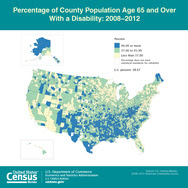
  Nearly 40 percent of people age 65 and older had at least one disability, according to a U.S. Census Bureau report that covered the period 2008 to 2012. Of those 15.7 million people, two-thirds of them say they had difficulty in walking or climbing.
  Difficulty with independent living, such as visiting a doctor’s office or shopping, was the second-most cited disability, followed by serious difficulty in hearing, cognitive difficulty, difficulty bathing or dressing, and serious difficulty seeing.
  While populous states such as California, Florida, New York and Texas had the largest number of older people with a disability, high disability rates were seen in Southern counties, especially in central Appalachia and the Mississippi Delta.
   Older Americans With a Disability: 2008-2012, a report based on data collected during the American Community Survey, examines disability status by age, sex and selected socio-economic characteristics, such as marital status, living arrangement, educational attainment and poverty status.

Tuesday, July 1, 2014

New Analysis of the State of the Nation’s 65-and-Older Population

A new report released by the U.S. Census Bureau provides the latest, comprehensive look at the nation’s population aged 65 and older, comprising 40.3 million in 2010.   
The 65+ in the United States: 2010 report contains many findings about the 65-and-older population on topics such as socio-economic characteristics, size and growth, geographic distribution, and longevity and health. For example, Americans 65 and olderliving in a nursing home fell 20 percent between 2000 and 2010, from 1.6 million to 1.3 million. Meanwhile, the share in other care settings has been growing.
“In the United States, older men and women are increasingly participating in the labor force,” said Enrique Lamas, the Census Bureau’s associate director for demographic programs. “The findings released today with the National Institute on Aging (NIA) at the National Institutes of Health provide the most detailed information available on the demographic, economic, and  health and wellness characteristics of this rapidly growing dynamic population.”

Thursday, May 1, 2014

Older Americans Month: May 2014


Older Americans Month: May 2014
A meeting with the National Council of Senior Citizens resulted in President John F. Kennedy designating May 1963 as Senior Citizens Month, encouraging the nation to pay tribute to older people across the country. In 1980, President Jimmy Carter’s proclamation changed the name to Older Americans Month, a time to celebrate those 65 and older through ceremonies, events and public recognition.
43.1 million
The number of people who were 65 and older in the United States on July 1, 2012. This group accounted for 13.7 percent of the total population. Source: U.S. Census Bureau, Population  Estimates
92.0 million
Projected population of people 65 and older in 2060. People in this age group would comprise just over one in five U.S. residents at that time. Of this number, 18.2 million would be 85 or older. Source: U.S. Census Bureau, Population Projections
2.4 million
Projected number of baby boomers in 2060. At that time, the youngest baby boomers would be 96 years old. Source: U.S. Census Bureau, Population Projections
2056
The year in which, for the first time, the population 65 and older would outnumber people younger than 18 in the U.S. Source: U.S. Census Bureau, Population Projections

Sunday, June 30, 2013

Older Americans Don't Like Living with Children

From the New Strategist:

That's a shocking statement, but it is supported by research findings: people aged 65 or older who live with children under age 18 are unhappier, angrier, more worried and stressed out than those who do not live with children--even after controlling for factors that might cause negative emotions.

In the delightfully titled study, Grandpa and the Snapper: The Wellbeing of the Elderly Who Live with Children, NBER researchers Angus Deaton and Arthur A. Stone examine data from the Gallup Healthways Wellbeing Index. They measure the happiness, enjoyment, worry, and stress of people who live with and without children under age 18. Younger adults gain both pleasure and pain from living with children, but for the elderly it's all pain and no pleasure.

"Our evidence suggests that living with children under 18 is associated with worse outcomes on all measures," say the researchers. "None of this is to argue that some elderly do not take pleasure in their grandchildren or in the children of those with whom they live. But, on average, we can find no evidence of it."

Monday, April 29, 2013

Older Americans Month: May 2013

From the Census Bureau:

A meeting with the National Council of Senior Citizens resulted in President John F. Kennedy designating May 1963 as Senior Citizens Month, encouraging the nation to pay tribute to older people across the country. In 1980, President Jimmy Carter's proclamation changed the name to Older Americans Month, a time to celebrate those 65 and older through ceremonies, events and public recognition.

41.4 million
The number of people who were 65 and older in the United States on July 1, 2011, up from 40.3 million on April 1, 2010 (Census Day). In 2011, this group accounted for 13.3 percent of the total population.

Tuesday, January 29, 2013

New Analyses of Census Data Examine Nation’s 65+ Labor Force, Working Students, Changes in Self-Employment


Three new American Community Survey briefs released today from the U.S. Census Bureau focus on individuals 65 and older in the labor force, students who are working or have worked in the past year, and the self-employed.

The percentage of people 65 and older in the labor force increased from 12.1 percent in 1990 to 16.1 percent in 2010. The increase was greater for women.

“As with all age groups, the increase in labor force participation of women has been a driving factor for this overall trend,” said Braedyn Kromer, an analyst in the Census Bureau’s Labor Force Statistics Branch.

Between 1990 and 2010, women 65 and older experienced a 4.1 percentage point increase in labor force participation, while women 16 to 64 experienced a 1.9 percentage point increase. This compares with a 3.2 percentage point increase in the labor force participation rate for men 65 and older and a 5.2 percentage point decline in the participation rate for men 16 to 64.

These statistics are part of a series of short, topic-based briefs produced to highlight results from the 2011 American Community Survey. The three briefs released are Labor Force Participation and Work Status of People 65 Years and Older, and School Enrollment and Work Status: 2011, and Changes in Self-Employment: 2010 to 2011.

“The American Community Survey allows us to measure important demographic characteristics of the nation's labor force and helps identify the impacts of changes in the labor market,” said Jennifer Cheeseman Day, assistant division chief for employment characteristics in the Census Bureau's Social, Economic and Housing Statistics Division.

The School Enrollment and Work Status: 2011 brief highlights statistics on school enrollment and examines the proportion of students who worked and the amount of time they worked over the previous year. For example, the majority of undergraduate college students, 72 percent, worked during the year. Some other highlights included in the brief are:

--In 2011, 20 percent of college undergraduate students worked full-time, year-round.
--Almost half of graduate students worked full-time, year-round.
--The majority of graduate students, 82 percent, worked at least part-time during the year.

The Changes in Self-Employment: 2010 to 2011 brief examines changes in self-employment from 2010 to 2011 for the United States, the 50 states, the District of Columbia and Puerto Rico. Self-employment refers to individuals working in their own incorporated or nonincorporated businesses. Some highlights included in the brief are:

--Incorporated self-employment fell as a share of total employment nationally and in 13 states between 2010 and 2011. It increased in one state and was essentially unchanged in 36 states, the District of Columbia and Puerto Rico.
--From 2010 to 2011, the share of nonincorporated self-employment of total employment decreased nationally and in five states (Colorado, New Hampshire, New York, Pennsylvania and Texas) and the District of Columbia. It increased in one state and Puerto Rico and was essentially unchanged in 44 states.
--In general, incorporated self-employed workers were more likely to work in management and professional occupations and had higher employment outcomes in 2011 than nonincorporated self-employed workers. The higher employment outcomes show that they were more likely to work full-time, year-round, have health insurance and earned higher incomes.

The American Community Survey provides a wide range of important statistics about people and housing for every community across the nation. The results are used by everyone from town and city planners to retailers and homebuilders. The survey is the only source of local estimates for most of the 40 topics it covers, such as education, occupation, language, ancestry and housing costs for even the smallest communities. Ever since Thomas Jefferson directed the first census in 1790, the census has collected detailed characteristics about our nation's people. Questions about jobs and the economy were added 20 years later under James Madison, who said such information would allow Congress to "adapt the public measures to the particular circumstances of the community," and over the decades, allow America "an opportunity of marking the progress of the society."

Friday, May 7, 2010

Income of the Population 55 or Older


This recently released biennial report from the Social Security Administration reveals the dependence of America's older generations on Social Security benefits. The report details the type and amount of income received by people aged 55 or older in 2008, examining economic status by a variety of demographic characteristics. One of the findings: Social Security accounts for fully 58 percent of the income received by people aged 65 or older. Private pensions account for only 8 percent.

description from the American Consumers Newsletter.