|
Showing posts with label Work. Show all posts
Showing posts with label Work. Show all posts
Friday, April 29, 2016
Bike to Work Week, May 16-20

Friday, August 21, 2015
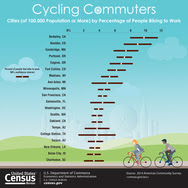
Census Bureau Releases Commuting Report
The U.S. Census Bureau released a report, Who Drives to Work? Commuting by Automobile in the United States, 2013, which looks at commuting by private vehicle. The report highlights differences in rates of automobile commuting by population characteristics such as age, race, ethnicity, place of birth and the types of communities in which workers live, based on data collected during the 2013 American Community Survey.
Also released is a county-to-county commuting flows table package that looks at traveling to work between counties and the primary travel mode people use, based on American Community Survey data collected from 2006 to 2013.
Highlights from the Report
- About 86 percent of U.S. workers commuted to work by automobile in 2013; three out of four commuters drove alone.
Monday, October 13, 2014
From Brazil to Uganda: What it takes to get ahead
The world may be flat these days, but the path to success differs around the globe. In some countries, education and hard work are enough. In others, connections and bribes play a big role. Pew Research surveyed people and asked them which factors are absolutely necessary to get ahead in their nation.
More from CNN.
More from CNN.
Thursday, April 18, 2013
College Enrollment and Work Activity of 2012 High School Graduates
In October 2012, 66.2 percent of 2012 high school graduates were enrolled in colleges or universities, the U.S. Bureau of Labor Statistics reported. Recent high school graduates not enrolled in college in October 2012 were more likely than enrolled graduates to be working or looking for work (69.6 percent compared with 38.2 percent)
More HERE.
More HERE.
Tuesday, September 29, 2009
Fatal work injuries down
Source: Bureau of Labor Statistics
A total of 5,071 fatal work injuries were recorded in the United States in 2008, down from a total of 5,657 fatal work injuries reported for 2007. While the 2008 results are preliminary, this figure represents the smallest annual preliminary total since the Census of Fatal Occupational Injuries (CFOI) program was first conducted in 1992. Final results for 2008 will be released in April 2010.
Based on these preliminary counts, the rate of fatal injury for U.S. workers in 2008 was 3.6 fatal work injuries per 100,000 full-time equivalent (FTE) workers, down from the final rate of 4.0 in 2007.
+ Full Report
A total of 5,071 fatal work injuries were recorded in the United States in 2008, down from a total of 5,657 fatal work injuries reported for 2007. While the 2008 results are preliminary, this figure represents the smallest annual preliminary total since the Census of Fatal Occupational Injuries (CFOI) program was first conducted in 1992. Final results for 2008 will be released in April 2010.
Based on these preliminary counts, the rate of fatal injury for U.S. workers in 2008 was 3.6 fatal work injuries per 100,000 full-time equivalent (FTE) workers, down from the final rate of 4.0 in 2007.
+ Full Report
Tuesday, May 26, 2009
U.S. Lags World in Paid Sick Days for Workers and Families
A new report from the Center for Economic and Policy Research (CEPR) shows that the United States is the only one of 22 rich countries that fails to guarantee sick workers some form of paid sick leave.
The report, Contagion Nation: A Comparison of Paid Sick Day Policies in 22 Countries, finds that the U.S. is the only country among 22 countries ranked highly in terms of economic and human development that does not guarantee that workers receive paid sick days or paid sick leave. Under current U.S. labor law, employers are not required to provide short-term paid sick days or longer-term paid sick leave.
![Reblog this post [with Zemanta]](http://img.zemanta.com/reblog_b.png?x-id=8bae8f3b-65ae-4171-a195-4c7005149f3e)
The report, Contagion Nation: A Comparison of Paid Sick Day Policies in 22 Countries, finds that the U.S. is the only country among 22 countries ranked highly in terms of economic and human development that does not guarantee that workers receive paid sick days or paid sick leave. Under current U.S. labor law, employers are not required to provide short-term paid sick days or longer-term paid sick leave.
Subscribe to:
Comments (Atom)