Over One-Quarter of Children Under Age 18 Live With One Parent
The percentage of children living with one parent who live with just their father saw an increase from 12.5 percent in 2007 to 16.1 percent in 2017. That’s according to new statistics from the U.S. Census Bureau’s 2017 America’s Families and Living Arrangements table package.
“A higher percentage of children living with one parent live with their fathers than a decade ago,” said Rose Kreider, a demographer in the Fertility and Family Statistics Branch at the Census Bureau. “However, the majority of children living with one parent still live with their mothers.”
In 2017, 83.9 percent of children living with one parent live with their mothers, compared to 86.0 percent in 2012 and 87.5 percent in 2007.
Overall, nearly 20 million children under age 18 live with one parent, composing 27.1 percent of all living arrangements for children under age 18. In 2007, 25.8 percent of children under age 18 lived with one parent, and in 2012, one of the highest intervening years, 28.3 percent of children under age 18 lived with one parent.
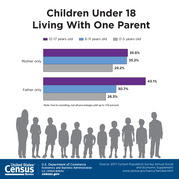
Of children who live with one parent, the most common marital status of the mother is never married (49 percent). The most common marital status of the father is divorced (43 percent). For children who live with their mother only, the largest proportions are ages 6 to 11 (36 percent), and ages 12 to 17 (35 percent). For children who live with their father only, the largest proportions are ages 12 to 17 (43 percent), followed by the proportion ages 6 to 11 (31 percent).
“The age distribution of children under age 18 who live with one parent shows a higher proportion of children living with their mother only are younger than children living with their father only,” Kreider said.
There continues to be racial and ethnic variation in living arrangements for children under age 18. Today, over half (52.8 percent) of black alone children live with one parent, compared to 29.1 percent of Hispanic children and 22.4 percent of white alone children.
Other highlights:
Households
· White householders make up 79 percent of all households in the United States, down from 89 percent in 1970. Black and Hispanic householders each make up 13 percent of households, while Asian householders comprise 5 percent. (Hispanics may be any race so percentages will not add to 100.)
· Households have grown smaller over time, reflecting the decrease in family size and the rise of living alone. The average number of people living in each household has declined from 3.7 people in 1940 to 2.5 today.
· In 2017, there are 35.3 million single-person households, composing 28 percent of all households. In 1960, single-person households represented only 13 percent of all households.
· Today less than 1 in 10 households (9 percent) have five or more people living in them – a decrease from 23 percent of households in 1960.
Marriage and Family
· In 2017, the median age when adults first marry is 29.5 for men and 27.4 for women, up from ages 23.7 and 20.5, respectively, in 1947. In 2017, less than one-third of all adults (32 percent) have never been married, up from 23 percent in 1950.
· More men (35 percent) than women (29 percent) have never been married in 2017 compared to 26 percent of men and 20 percent of women in 1950.
· Married couples make up 69 percent of all families with children under age 18, compared to 93 percent in 1950.
· In 19 percent of married-couple households, neither the husband nor wife is in the labor force. Among married-couple households with neither spouse in the labor force, 75 percent are age 65 and older.
· Over a quarter (26 percent) of children under the age of 15 who live in married-couple families have a stay at home mother, compared to only 1 percent who have a stay at home father.
Living Arrangements of Adults and Children
· Over half (55 percent) of young adults ages 18 to 24 live in the parental home, compared to 16 percent of young adults ages 25 to 34.
· Of the 64 million parents living with children under the age of 18, 4.9 million (8 percent) are unmarried cohabiting parents.
· Most adults between the ages of 65 to 74 still live with a spouse. For men in this age group, 72 percent live with a spouse, while for women the percentage is 56 percent. For adults age 75 and older, however, the percentage of those living with a spouse drops to 66 percent for men and just 33 percent for women.
Unmarried Couples
· In 2017, there are 7.8 million unmarried opposite-sex couples living together.
· Of the unmarried opposite-sex couples living together, 37 percent live with children under the age of 18.
These statistics come from the 2017 Current Population Survey Annual Social and Economic Supplement, which has collected statistics on families for more than 60 years. The data shows characteristics of households, living arrangements, married and unmarried couples, and children.
For more information, see Families and Living Arrangements or visit census.gov.
|
Showing posts with label households. Show all posts
Showing posts with label households. Show all posts
Friday, November 17, 2017
More Children Live With Just Their Fathers Than a Decade Ago

Thursday, July 17, 2014
Longitudinal Employer-Household Dynamics
The Longitudinal Employer-Household Dynamics (LEHD) program is part of the Center for Economic Studies at the U.S. Census Bureau. The LEHD program produces new, cost effective, public-use information combining federal, state and Census Bureau data on employers and employees under the Local Employment Dynamics (LED) Partnership. State and local authorities increasingly need detailed local information about their economies to make informed decisions. The LED Partnership works to fill critical data gaps and provide indicators needed by state and local authorities.
Under the LED Partnership, states agree to share Unemployment Insurance earnings data and the Quarterly Census of Employment and Wages (QCEW) data with the Census Bureau. The LEHD program combines these administrative data, additional administrative data and data from censuses and surveys. From these data, the program creates statistics on employment, earnings, and job flows at detailed levels of geography and industry and for different demographic groups. In addition, the LEHD program uses these data to create partially synthetic data on workers' residential patterns.
All 50 states, the District of Columbia, Puerto Rico, and the U.S. Virgin Islands have joined the LED Partnership, although the LEHD program is not yet producing public-use statistics for Massachusetts, Puerto Rico, or the U.S. Virgin Islands. The LEHD program staff includes geographers, programmers, and economists.
The mission is to provide new dynamic information on workers, employers, and jobs with state-of-the-art confidentiality protections and no additional data collection burden.
Friday, September 20, 2013
U.S. Census Bureau Releases 2012 American Community Survey (ACS) 1-Year Statistics
The Census Bureau is pleased to announce the release of the 2012 American Community Survey (ACS) 1-Year statistics, the most relied-on source for up-to-date social, economic, and housing information every year. The survey is the only source of local statistics for most of the 40 topics it covers, such as educational attainment, occupation, language spoken at home, nativity, ancestry and selected monthly homeowner costs. The statistics are available for the nation, all 50 states, the District of Columbia, Puerto Rico, every congressional district, every metropolitan area, and all counties and places with populations of 65,000 or more.
To find statistics for your area, please visit the Census Bureau's American FactFinder.
To learn more about this release, visit our 2012 Data Release page.
In addition, the Census Bureau released a set of American Community Survey Briefs.
These short reports supplement detailed tables with additional analysis on three key topics. These include the following:
• Poverty: 2000 to 2012
• Household Income: 2012
• Mitigating the Loss of Private Insurance with Public Coverage for the Under-65 Population: 2008 to 2012
The ACS provides reliable statistics that are indispensable to anyone who has to make informed decisions about the future. These statistics are required by all levels of government to manage or evaluate a wide range of programs, but are also useful for research, education, journalism, business and advocacy. If you have questions about this survey, please call the Customer Services Center at 1 (800) 923-8282.
To find statistics for your area, please visit the Census Bureau's American FactFinder.
To learn more about this release, visit our 2012 Data Release page.
In addition, the Census Bureau released a set of American Community Survey Briefs.
These short reports supplement detailed tables with additional analysis on three key topics. These include the following:
• Poverty: 2000 to 2012
• Household Income: 2012
• Mitigating the Loss of Private Insurance with Public Coverage for the Under-65 Population: 2008 to 2012
The ACS provides reliable statistics that are indispensable to anyone who has to make informed decisions about the future. These statistics are required by all levels of government to manage or evaluate a wide range of programs, but are also useful for research, education, journalism, business and advocacy. If you have questions about this survey, please call the Customer Services Center at 1 (800) 923-8282.
Tuesday, June 4, 2013
Arab Households in the United States: 2006-2010
This American Community Survey brief provides a national-level portrait of U.S. households with a particular focus on Arab households; people of specific Arab ancestries, such as Lebanese and Egyptian, are also discussed. This brief examines several characteristics for all households and those with an Arab householder: average household size, household type, homeownership and median household income.
Thursday, March 21, 2013
Household Debt in the U.S.: 2000 to 2011 and Measuring the Wealth of U.S. Households
The percentage of U.S. households holding some form of debt declined from 74 percent to 69 percent between 2000 and 2011, according to new statistics released today by the U.S. Census Bureau. At the same time, the median amount of household debt increased over this period from $50,971 to $70,000 (in 2011 constant dollars). These statistics are part of a larger package released today that contains statistics on household wealth, asset ownership and debt.
These statistics come from Household Debt in the U.S.: 2000 to 2011 and accompanying detailed tables that examine the median value of debt and percent holding debt for households, by various characteristics of the householder, such as race and Hispanic origin, age, education and income quintile.
Between 2000 and 2011, the largest increases in median debt were experienced in households with householders age 35 to 44 (to $108,000), 45 to 54 (to $86,500) and 55 to 64 (to $70,000). However, the largest percentage increases in debt belonged to householders 55 to 64 years old (64 percent) and 65 and older (more than doubling to $26,000). Furthermore, people 65 and older were the only age group whose likelihood of holding debt rose over the period (from 41 percent to 44 percent). The opposite pattern was observed for those under 65.
“Those 65 and over became more likely to hold debt against their homes, and their median housing debt increased, as well, which explains a significant portion of the increase in their overall debt between 2000 and 2011,” Census Bureau economist Marina Vornovytskyy said.
During the period, the composition of debt held by households also changed considerably. While the percentage holding credit card debt declined from 51 percent in 2000 to 38 percent in 2011, the percentage holding other unsecured debt, such as educational loans and medical bills not covered by insurance, rose from 11 percent to 19 percent.
“Householders under age 45 experienced the largest increases in both the likelihood of holding other debt and the amount of other debt,” Vornovytskyy said.
Also released was Household Wealth in the U.S.: 2000 to 2011 and associated detailed tables that examine the median value of assets and percent holding assets for households in 2011, by type of asset owned and householder characteristics similar to those explored in Household Debt in the U.S.: 2000 to 2011.
According to Household Wealth in the U.S.: 2000 to 2011, median net worth rose from $81,821 in 2000 to $106,585 in 2005, before declining to $68,828 in 2011 (in 2011 constant dollars). Median net worth excluding home equity has not exhibited the same degree of variability as overall median net worth: it showed no statistically significant change between 2000 and 2005 and decreased by $3,815 (or 18 percent) between 2005 and 2011.
"The changes in overall median net worth observed over the past decade have been driven primarily by changes in one of its major components — equity that American households hold in their homes," Census Bureau economist Alfred Gottschalck said.
Over this same time period, there was significant regional variation in the changes in median net worth. The West experienced the largest changes over the last decade, increasing from $78,999 in 2000 to $146,841 in 2005 and then decreasing to $59,431 by 2011.
Between 2010 and 2011, median net worth showed no statistically significant change. Median net worth excluding home equity increased from $15,546 to $16,942.
These statistics come from Household Debt in the U.S.: 2000 to 2011 and accompanying detailed tables that examine the median value of debt and percent holding debt for households, by various characteristics of the householder, such as race and Hispanic origin, age, education and income quintile.
Between 2000 and 2011, the largest increases in median debt were experienced in households with householders age 35 to 44 (to $108,000), 45 to 54 (to $86,500) and 55 to 64 (to $70,000). However, the largest percentage increases in debt belonged to householders 55 to 64 years old (64 percent) and 65 and older (more than doubling to $26,000). Furthermore, people 65 and older were the only age group whose likelihood of holding debt rose over the period (from 41 percent to 44 percent). The opposite pattern was observed for those under 65.
“Those 65 and over became more likely to hold debt against their homes, and their median housing debt increased, as well, which explains a significant portion of the increase in their overall debt between 2000 and 2011,” Census Bureau economist Marina Vornovytskyy said.
During the period, the composition of debt held by households also changed considerably. While the percentage holding credit card debt declined from 51 percent in 2000 to 38 percent in 2011, the percentage holding other unsecured debt, such as educational loans and medical bills not covered by insurance, rose from 11 percent to 19 percent.
“Householders under age 45 experienced the largest increases in both the likelihood of holding other debt and the amount of other debt,” Vornovytskyy said.
Also released was Household Wealth in the U.S.: 2000 to 2011 and associated detailed tables that examine the median value of assets and percent holding assets for households in 2011, by type of asset owned and householder characteristics similar to those explored in Household Debt in the U.S.: 2000 to 2011.
According to Household Wealth in the U.S.: 2000 to 2011, median net worth rose from $81,821 in 2000 to $106,585 in 2005, before declining to $68,828 in 2011 (in 2011 constant dollars). Median net worth excluding home equity has not exhibited the same degree of variability as overall median net worth: it showed no statistically significant change between 2000 and 2005 and decreased by $3,815 (or 18 percent) between 2005 and 2011.
"The changes in overall median net worth observed over the past decade have been driven primarily by changes in one of its major components — equity that American households hold in their homes," Census Bureau economist Alfred Gottschalck said.
Over this same time period, there was significant regional variation in the changes in median net worth. The West experienced the largest changes over the last decade, increasing from $78,999 in 2000 to $146,841 in 2005 and then decreasing to $59,431 by 2011.
Between 2010 and 2011, median net worth showed no statistically significant change. Median net worth excluding home equity increased from $15,546 to $16,942.
Thursday, February 14, 2013
The Geographic Concentration of High-Income Households: 2007–2011
Two questions present themselves when considering the geographic concentration of high-income households. First, where do most high-income households live? Second, where are the highest concentrations of high-income households?
More from the Census Bureau.
More from the Census Bureau.
Friday, December 14, 2012
More Adults Living in Shared Households, More Receiving Food Stamps, Public Assistance Unchanged
In 2011, 17.9 percent of people 18 and older lived in someone else’s household, up from 16.0 percent in 2007, prior to the start of the economic recession, the U.S. Census Bureau reported. Specifically, 41.2 million adults in 2011 lived in a household in which they were neither the householder, the householder’s spouse nor the householder’s cohabiting partner. Between 2010 and 2011, the number of these additional adults increased by 1.9 million, from 17.3 percent to 17.9 percent of adults.
This information comes from Poverty and Shared Households by State: 2011, one of three briefs recently released highlighting economic conditions using statistics from the American Community Survey. The other briefs examine levels of participation in food stamp, nutrition assistance and public assistance programs.
Poverty and Shared Households by State: 2011 explores the growth in households that contain an “additional adult” (a resident 18 and older who is neither the householder, the householder’s spouse, nor the householder’s cohabiting partner). This brief also provides information at the state level between 2007 and 2011 and examines whether or not household sharing is influenced by economic circumstances.
In recent years, shared households have increased as a proportion of all U.S. households. In 2007, prior to the start of the economic recession, 19.8 million or 17.6 percent of households were shared. Nationally, shared households peaked in 2010 at 22.2 million or 19.4 percent of all households and declined to 22.0 million or 19.2 percent of households in 2011.
In the District of Columbia, California, Florida, Hawaii, New York and Nevada, 20 percent or more of the population 18 and older lived in someone else’s household in 2011, the highest shares among the states and the state equivalents.
The number and percentage of these additional adults increased in 40 states between 2007 and 2011 with larger increases in the South. Florida experienced a 4.4 percentage point increase to lead all states, followed by Nevada (3.9 percentage points).
In 2011, more than one in three young adults 18 to 24 were residents in someone else’s household; the same was true of more than 30 percent of those 25 to 34. For the latter group, the share of additional adults increased by 4.5 percentage points since 2007, compared with a 1.7 percentage-point increase for those 18 to 24.
States in which more than one-third of young adults 25 to 34 were additional adults included California, Florida, Hawaii, Maryland, New Jersey and New York.
Almost half of all additional adults were children of the householder. Additional adults can also be parents of the householder (9.6 percent), siblings (8.1 percent) and other relatives (16.0 percent). Nonrelatives accounted for the remaining 19.2 percent. The share of additional adults who were children of the householder increased by 1.7 percentage points between 2007 and 2011, while the percentage who were parents or nonrelatives declined.
Many of the adults sharing a household with relatives would have been in poverty if they had been living on their own. The official poverty rate for additional adults (based on family income) in 2011 was 15.8 percent. However, their individual poverty rate was 55.5 percent. (This “individual” poverty measure looks at what the poverty rate would be if the additional adults lived alone.)
Food Stamp/SNAP Receipt
A second brief, Food Stamp/Supplemental Nutrition Assistance Program Receipt in the Past 12 Months for Households by State: 2010 and 2011, presents American Community Survey statistics for households at national and state levels. The brief shows that in 2011, 14.9 million households, or 13 percent, reported receiving such benefits during the past 12 months, up from 11.9 percent in 2010. Forty-seven states and the District of Columbia experienced a rise in participation, with the District of Columbia, Alabama and Hawaii among the states with the largest increases. In 2011, Oregon had the highest participation rate (18.9 percent).
Public Assistance Receipt
The third brief, Public Assistance Receipt in the Past 12 Months for Households: 2010 and 2011, analyzes American Community Survey data at the national and state levels. According to the brief, 3.3 million households, or 2.9 percent, in 2011 reported receiving some form of public assistance benefits at some point in the previous 12 months. For the first time in several years, there was no significant increase in the number or percentage of American households receiving public assistance benefits relative to the previous year.
Also, for the first time in several years, the percentage of households receiving public assistance declined in some states. Four states (Indiana, Iowa, New Hampshire and Utah) and the District of Columbia had lower participation rates in 2011 compared with 2010. However, seven states (Arkansas, Hawaii, Idaho, Maryland, Oklahoma, Tennessee and Virginia) had increases between 2010 and 2011 in participation rates.
Seventeen states — concentrated in the West and Northeast — and the District of Columbia had a higher participation rate in the percentage of households receiving public assistance than the national average. Conversely, 24 states had lower participation rates than the U.S. average, with 11 of them in the South and nine in the Midwest.
The American Community Survey provides a wide range of important statistics about people and housing for every community across the nation. The results are used by everyone from retailers and homebuilders to town and city planners. The survey is the only source of local estimates for most of the 40 topics it covers, such as education, occupation, language, ancestry and housing costs for even the smallest communities. Ever since Thomas Jefferson directed the first census in 1790, the census has collected detailed characteristics about our nation's people, and questions about our economy were added under President Madison in 1810.
This information comes from Poverty and Shared Households by State: 2011, one of three briefs recently released highlighting economic conditions using statistics from the American Community Survey. The other briefs examine levels of participation in food stamp, nutrition assistance and public assistance programs.
Poverty and Shared Households by State: 2011 explores the growth in households that contain an “additional adult” (a resident 18 and older who is neither the householder, the householder’s spouse, nor the householder’s cohabiting partner). This brief also provides information at the state level between 2007 and 2011 and examines whether or not household sharing is influenced by economic circumstances.
In recent years, shared households have increased as a proportion of all U.S. households. In 2007, prior to the start of the economic recession, 19.8 million or 17.6 percent of households were shared. Nationally, shared households peaked in 2010 at 22.2 million or 19.4 percent of all households and declined to 22.0 million or 19.2 percent of households in 2011.
In the District of Columbia, California, Florida, Hawaii, New York and Nevada, 20 percent or more of the population 18 and older lived in someone else’s household in 2011, the highest shares among the states and the state equivalents.
The number and percentage of these additional adults increased in 40 states between 2007 and 2011 with larger increases in the South. Florida experienced a 4.4 percentage point increase to lead all states, followed by Nevada (3.9 percentage points).
In 2011, more than one in three young adults 18 to 24 were residents in someone else’s household; the same was true of more than 30 percent of those 25 to 34. For the latter group, the share of additional adults increased by 4.5 percentage points since 2007, compared with a 1.7 percentage-point increase for those 18 to 24.
States in which more than one-third of young adults 25 to 34 were additional adults included California, Florida, Hawaii, Maryland, New Jersey and New York.
Almost half of all additional adults were children of the householder. Additional adults can also be parents of the householder (9.6 percent), siblings (8.1 percent) and other relatives (16.0 percent). Nonrelatives accounted for the remaining 19.2 percent. The share of additional adults who were children of the householder increased by 1.7 percentage points between 2007 and 2011, while the percentage who were parents or nonrelatives declined.
Many of the adults sharing a household with relatives would have been in poverty if they had been living on their own. The official poverty rate for additional adults (based on family income) in 2011 was 15.8 percent. However, their individual poverty rate was 55.5 percent. (This “individual” poverty measure looks at what the poverty rate would be if the additional adults lived alone.)
Food Stamp/SNAP Receipt
A second brief, Food Stamp/Supplemental Nutrition Assistance Program Receipt in the Past 12 Months for Households by State: 2010 and 2011, presents American Community Survey statistics for households at national and state levels. The brief shows that in 2011, 14.9 million households, or 13 percent, reported receiving such benefits during the past 12 months, up from 11.9 percent in 2010. Forty-seven states and the District of Columbia experienced a rise in participation, with the District of Columbia, Alabama and Hawaii among the states with the largest increases. In 2011, Oregon had the highest participation rate (18.9 percent).
Public Assistance Receipt
The third brief, Public Assistance Receipt in the Past 12 Months for Households: 2010 and 2011, analyzes American Community Survey data at the national and state levels. According to the brief, 3.3 million households, or 2.9 percent, in 2011 reported receiving some form of public assistance benefits at some point in the previous 12 months. For the first time in several years, there was no significant increase in the number or percentage of American households receiving public assistance benefits relative to the previous year.
Also, for the first time in several years, the percentage of households receiving public assistance declined in some states. Four states (Indiana, Iowa, New Hampshire and Utah) and the District of Columbia had lower participation rates in 2011 compared with 2010. However, seven states (Arkansas, Hawaii, Idaho, Maryland, Oklahoma, Tennessee and Virginia) had increases between 2010 and 2011 in participation rates.
Seventeen states — concentrated in the West and Northeast — and the District of Columbia had a higher participation rate in the percentage of households receiving public assistance than the national average. Conversely, 24 states had lower participation rates than the U.S. average, with 11 of them in the South and nine in the Midwest.
The American Community Survey provides a wide range of important statistics about people and housing for every community across the nation. The results are used by everyone from retailers and homebuilders to town and city planners. The survey is the only source of local estimates for most of the 40 topics it covers, such as education, occupation, language, ancestry and housing costs for even the smallest communities. Ever since Thomas Jefferson directed the first census in 1790, the census has collected detailed characteristics about our nation's people, and questions about our economy were added under President Madison in 1810.
Friday, November 30, 2012
More Adults Living in Shared Households, More Receiving Food Stamps, Public Asistance Unchanged
In 2011, 17.9 percent of people 18 and older lived in someone else’s household, up from 16.0 percent in 2007, prior to the start of the economic recession, the U.S. Census Bureau reported. Specifically, 41.2 million adults in 2011 lived in a household in which they were neither the householder, the householder’s spouse nor the householder’s cohabiting partner. Between 2010 and 2011, the number of these additional adults increased by 1.9 million, from 17.3 percent to 17.9 percent of adults.
This information comes from Poverty and Shared Households by State: 2011, which explores the growth in households that contain an “additional adult” (a resident 18 and older who is neither the householder, the householder’s spouse, nor the householder’s cohabiting partner). This brief also provides information at the state level between 2007 and 2011 and examines whether or not household sharing is influenced by economic circumstances.
In recent years, shared households have increased as a proportion of all U.S. households. In 2007, prior to the start of the economic recession, 19.8 million or 17.6 percent of households were shared. Nationally, shared households peaked in 2010 at 22.2 million or 19.4 percent of all households and declined to 22.0 million or 19.2 percent of households in 2011.
In the District of Columbia, California, Florida, Hawaii, New York and Nevada, 20 percent or more of the population 18 and older lived in someone else’s household in 2011, the highest shares among the states and the state equivalents.
The number and percentage of these additional adults increased in 40 states between 2007 and 2011 with larger increases in the South. Florida experienced a 4.4 percentage point increase to lead all states, followed by Nevada (3.9 percentage points).
In 2011, more than one in three young adults 18 to 24 were residents in someone else’s household; the same was true of more than 30 percent of those 25 to 34. For the latter group, the share of additional adults increased by 4.5 percentage points since 2007, compared with a 1.7 percentage-point increase for those 18 to 24.
States in which more than one-third of young adults 25 to 34 were additional adults included California, Florida, Hawaii, Maryland, New Jersey and New York.
Almost half of all additional adults were children of the householder. Additional adults can also be parents of the householder (9.6 percent), siblings (8.1 percent) and other relatives (16.0 percent). Nonrelatives accounted for the remaining 19.2 percent. The share of additional adults who were children of the householder increased by 1.7 percentage points between 2007 and 2011, while the percentage who were parents or nonrelatives declined.
Many of the adults sharing a household with relatives would have been in poverty if they had been living on their own. The official poverty rate for additional adults (based on family income) in 2011 was 15.8 percent. However, their individual poverty rate was 55.5 percent. (This “individual” poverty measure looks at what the poverty rate would be if the additional adults lived alone.)
Food Stamp/SNAP Receipt
A second brief released Food Stamp/Supplemental Nutrition Assistance Program Receipt in the Past 12 Months for Households by State: 2010 and 2011, presents American Community Survey statistics for households at national and state levels. The brief shows that in 2011, 14.9 million households, or 13 percent, reported receiving such benefits during the past 12 months, up from 11.9 percent in 2010. Forty-seven states and the District of Columbia experienced a rise in participation, with the District of Columbia, Alabama and Hawaii among the states with the largest increases. In 2011, Oregon had the highest participation rate (18.9 percent).
Public Assistance Receipt
The third brief, Public Assistance Receipt in the Past 12 Months for Households: 2010 and 2011, analyzes American Community Survey data at the national and state levels. According to the brief, 3.3 million households, or 2.9 percent, in 2011 reported receiving some form of public assistance benefits at some point in the previous 12 months. For the first time in several years, there was no significant increase in the number or percentage of American households receiving public assistance benefits relative to the previous year.
Also, for the first time in several years, the percentage of households receiving public assistance declined in some states. Four states (Indiana, Iowa, New Hampshire and Utah) and the District of Columbia had lower participation rates in 2011 compared with 2010. However, seven states (Arkansas, Hawaii, Idaho, Maryland, Oklahoma, Tennessee and Virginia) had increases between 2010 and 2011 in participation rates.
Seventeen states — concentrated in the West and Northeast — and the District of Columbia had a higher participation rate in the percentage of households receiving public assistance than the national average. Conversely, 24 states had lower participation rates than the U.S. average, with 11 of them in the South and nine in the Midwest.
The American Community Survey provides a wide range of important statistics about people and housing for every community across the nation. The results are used by everyone from retailers and homebuilders to town and city planners. The survey is the only source of local estimates for most of the 40 topics it covers, such as education, occupation, language, ancestry and housing costs for even the smallest communities. Ever since Thomas Jefferson directed the first census in 1790, the census has collected detailed characteristics about our nation's people, and questions about our economy were added under President Madison in 1810.
Robert Bernstein
Public Information Office
301-763-3030
This information comes from Poverty and Shared Households by State: 2011, which explores the growth in households that contain an “additional adult” (a resident 18 and older who is neither the householder, the householder’s spouse, nor the householder’s cohabiting partner). This brief also provides information at the state level between 2007 and 2011 and examines whether or not household sharing is influenced by economic circumstances.
In recent years, shared households have increased as a proportion of all U.S. households. In 2007, prior to the start of the economic recession, 19.8 million or 17.6 percent of households were shared. Nationally, shared households peaked in 2010 at 22.2 million or 19.4 percent of all households and declined to 22.0 million or 19.2 percent of households in 2011.
In the District of Columbia, California, Florida, Hawaii, New York and Nevada, 20 percent or more of the population 18 and older lived in someone else’s household in 2011, the highest shares among the states and the state equivalents.
The number and percentage of these additional adults increased in 40 states between 2007 and 2011 with larger increases in the South. Florida experienced a 4.4 percentage point increase to lead all states, followed by Nevada (3.9 percentage points).
In 2011, more than one in three young adults 18 to 24 were residents in someone else’s household; the same was true of more than 30 percent of those 25 to 34. For the latter group, the share of additional adults increased by 4.5 percentage points since 2007, compared with a 1.7 percentage-point increase for those 18 to 24.
States in which more than one-third of young adults 25 to 34 were additional adults included California, Florida, Hawaii, Maryland, New Jersey and New York.
Almost half of all additional adults were children of the householder. Additional adults can also be parents of the householder (9.6 percent), siblings (8.1 percent) and other relatives (16.0 percent). Nonrelatives accounted for the remaining 19.2 percent. The share of additional adults who were children of the householder increased by 1.7 percentage points between 2007 and 2011, while the percentage who were parents or nonrelatives declined.
Many of the adults sharing a household with relatives would have been in poverty if they had been living on their own. The official poverty rate for additional adults (based on family income) in 2011 was 15.8 percent. However, their individual poverty rate was 55.5 percent. (This “individual” poverty measure looks at what the poverty rate would be if the additional adults lived alone.)
Food Stamp/SNAP Receipt
A second brief released Food Stamp/Supplemental Nutrition Assistance Program Receipt in the Past 12 Months for Households by State: 2010 and 2011, presents American Community Survey statistics for households at national and state levels. The brief shows that in 2011, 14.9 million households, or 13 percent, reported receiving such benefits during the past 12 months, up from 11.9 percent in 2010. Forty-seven states and the District of Columbia experienced a rise in participation, with the District of Columbia, Alabama and Hawaii among the states with the largest increases. In 2011, Oregon had the highest participation rate (18.9 percent).
Public Assistance Receipt
The third brief, Public Assistance Receipt in the Past 12 Months for Households: 2010 and 2011, analyzes American Community Survey data at the national and state levels. According to the brief, 3.3 million households, or 2.9 percent, in 2011 reported receiving some form of public assistance benefits at some point in the previous 12 months. For the first time in several years, there was no significant increase in the number or percentage of American households receiving public assistance benefits relative to the previous year.
Also, for the first time in several years, the percentage of households receiving public assistance declined in some states. Four states (Indiana, Iowa, New Hampshire and Utah) and the District of Columbia had lower participation rates in 2011 compared with 2010. However, seven states (Arkansas, Hawaii, Idaho, Maryland, Oklahoma, Tennessee and Virginia) had increases between 2010 and 2011 in participation rates.
Seventeen states — concentrated in the West and Northeast — and the District of Columbia had a higher participation rate in the percentage of households receiving public assistance than the national average. Conversely, 24 states had lower participation rates than the U.S. average, with 11 of them in the South and nine in the Midwest.
The American Community Survey provides a wide range of important statistics about people and housing for every community across the nation. The results are used by everyone from retailers and homebuilders to town and city planners. The survey is the only source of local estimates for most of the 40 topics it covers, such as education, occupation, language, ancestry and housing costs for even the smallest communities. Ever since Thomas Jefferson directed the first census in 1790, the census has collected detailed characteristics about our nation's people, and questions about our economy were added under President Madison in 1810.
Robert Bernstein
Public Information Office
301-763-3030
Tuesday, June 26, 2012
Thursday, June 21, 2012
Census Bureau Report Shows Shared Households Increased 11.4 Percent from 2007 to 2010
The report, Sharing a Household: Household Composition and Economic Well-Being: 2007-2010 [PDF], analyzes data on household composition and income from the Annual Social and Economic Supplement of the Current Population Survey. The report reveals that adults joined or combined their households in greater numbers and in higher proportions following the most recent recession than they did prior to the recession.
In spring 2007, there were 19.7 million shared households — defined as a household with at least one “additional” adult. An additional adult is a person 18 or older who is not enrolled in school and is neither the householder, the spouse nor the cohabiting partner of the householder. By spring 2010, the number of shared households had increased to 22.0 million while all households increased by only 1.3 percent.
More info HERE.
In spring 2007, there were 19.7 million shared households — defined as a household with at least one “additional” adult. An additional adult is a person 18 or older who is not enrolled in school and is neither the householder, the spouse nor the cohabiting partner of the householder. By spring 2010, the number of shared households had increased to 22.0 million while all households increased by only 1.3 percent.
More info HERE.
Thursday, March 15, 2012
Household Income Inequality Within U.S. Counties: 2006-2010
This report [PDF] presents measures of household income inequality for counties in the United States, based on data pooled from 5 years (2006 to 2010) of American Community Survey (ACS) data. For example, the data show that the more unequal counties were also more populous. Thirty-four percent of Americans lived in a county that ranked in the top 20 percent of U.S. counties by Gini index (the Gini index is a measure of income inequality).
In every region, the counties in the most unequal fifth of U.S. counties accounted for a disproportionately large share of that region's population. For example, only 8 percent of Midwestern counties had Gini indexes ranking among the top fifth of U.S. counties, but they contained 26 percent of the region's population. Also, the South region had a disproportionately large number of counties with high income inequality, while counties in the Midwest had lower levels of income inequality. Specifically, 32 percent of the counties in the South had Gini indexes ranking among the top fifth of U.S. counties, while 31 percent of Midwest counties ranked among the bottom fifth of U.S. counties.
In every region, the counties in the most unequal fifth of U.S. counties accounted for a disproportionately large share of that region's population. For example, only 8 percent of Midwestern counties had Gini indexes ranking among the top fifth of U.S. counties, but they contained 26 percent of the region's population. Also, the South region had a disproportionately large number of counties with high income inequality, while counties in the Midwest had lower levels of income inequality. Specifically, 32 percent of the counties in the South had Gini indexes ranking among the top fifth of U.S. counties, while 31 percent of Midwest counties ranked among the bottom fifth of U.S. counties.
Monday, October 24, 2011
Household spending cuts
Some of my colleagues were interested to know if there is research regarding where consumers cut back first, second, etc., when times
are hard. This is different than what one OUGHT to cut back in hard
times, for which I find oodles of examples; I was looking for what people
ACTUALLY do.
Where Would You Cut Your Household Budget First? (2007) is interesting but flawed, in that it reflects what people saw they would do if there were hard times. But at the time, things seemed rosy.
More useful were Psychology of Bad Times Fueling Consumer Cutbacks (2008) and Consumer Cutbacks: Temporary or Permanent? (2009), which reported on actual hard-times responses.
Also very helpful: Americans Cutting Back on Everyday Expenses to Save Money (Harris poll, 2011).
Addressing the issue from a different angle: 12 Things We Buy in a Bad Economy (TIME - 2011)
But THE treasure trove, if one takes the time to study it, is the Consumer Expenditure Survey from the US Department of Labor, especially the most recent multiyear table (2006-2010 PDF), as well as the ones for previous years, going back to 1981.
Thanks to Alisa Coddington, John Skutnik, Terese Mulkern Terry, and Chantal Walvoord for their wisdom.
are hard. This is different than what one OUGHT to cut back in hard
times, for which I find oodles of examples; I was looking for what people
ACTUALLY do.
Where Would You Cut Your Household Budget First? (2007) is interesting but flawed, in that it reflects what people saw they would do if there were hard times. But at the time, things seemed rosy.
More useful were Psychology of Bad Times Fueling Consumer Cutbacks (2008) and Consumer Cutbacks: Temporary or Permanent? (2009), which reported on actual hard-times responses.
Also very helpful: Americans Cutting Back on Everyday Expenses to Save Money (Harris poll, 2011).
Addressing the issue from a different angle: 12 Things We Buy in a Bad Economy (TIME - 2011)
But THE treasure trove, if one takes the time to study it, is the Consumer Expenditure Survey from the US Department of Labor, especially the most recent multiyear table (2006-2010 PDF), as well as the ones for previous years, going back to 1981.
Thanks to Alisa Coddington, John Skutnik, Terese Mulkern Terry, and Chantal Walvoord for their wisdom.
Monday, April 25, 2011
Monday, November 15, 2010
Men and Women Wait Longer to Marry
The median age at first marriage increased to 28.2 for men and 26.1 for women in 2010, an increase from 26.8 and 25.1 in 2000, according to the U.S. Census Bureau. This increase is a continuation of a long-term trend that has been noted since the mid-1950s. In addition, the overall percentage of adults who were married declined to 54.1 percent in 2010 from 57.3 percent in 2000.
According to America's Families and Living Arrangements: 2010, the average household size declined to 2.59 in 2010, from 2.62 people in 2000. This is partly because of the increase in one-person households, which rose from 25 percent in 2000 to 27 percent in 2010, more than double the percentage in 1960 (13 percent).
More HERE.
According to America's Families and Living Arrangements: 2010, the average household size declined to 2.59 in 2010, from 2.62 people in 2000. This is partly because of the increase in one-person households, which rose from 25 percent in 2000 to 27 percent in 2010, more than double the percentage in 1960 (13 percent).
More HERE.
Thursday, February 11, 2010
The Decline and Fall of the Nation's Peak Earners
In the American Consumers Newsletter for February 11, 2010, Elizabeth Warren notes that the decline of the American middle class predated the recent recession:
Household income is down. Household income follows a trajectory, starting low among young adults, rising as people gain experience in their career, peaking in the 45-to-54 age group, then falling as people begin to retire. Householders aged 45 to 54 are still the nation's peak earners, but they stand atop a much smaller hill than they once did. Here is the thirty-year trend in the median income of householders aged 45 to 54 (in 2008 dollars):
Median Income, Householders Aged 45 to 54
2008 $64,349
1998 $71,429
1988 $66,830
1978 $64,152
That's right. The median household income of today's peak earners is only $197 more than the median income of the same age group in 1978. Their median income is $2,481 less than the income of the same age group in 1988. It is $7,080 less than the median income of the same age group in 1998. The stagnation and decline of the household incomes of peak earners has occurred despite growing numbers of working women. In 1978, only 57 percent of women aged 45 to 54 were in the labor force. Today, 76 percent are working.
Household income is down. Household income follows a trajectory, starting low among young adults, rising as people gain experience in their career, peaking in the 45-to-54 age group, then falling as people begin to retire. Householders aged 45 to 54 are still the nation's peak earners, but they stand atop a much smaller hill than they once did. Here is the thirty-year trend in the median income of householders aged 45 to 54 (in 2008 dollars):
Median Income, Householders Aged 45 to 54
2008 $64,349
1998 $71,429
1988 $66,830
1978 $64,152
That's right. The median household income of today's peak earners is only $197 more than the median income of the same age group in 1978. Their median income is $2,481 less than the income of the same age group in 1988. It is $7,080 less than the median income of the same age group in 1998. The stagnation and decline of the household incomes of peak earners has occurred despite growing numbers of working women. In 1978, only 57 percent of women aged 45 to 54 were in the labor force. Today, 76 percent are working.
Thursday, October 8, 2009
America’s Families and Living Arrangements 2007
Highlights of the Census Bureau report include:
* 68% of households in 2007 were family households, compared with 81% in 1970.
* The proportion of one-person households increased by 10 percentage points between 1970 and 2007, from 17% to 27%.
* Between 1970 and 2007, the average number of people per household declined from 3.1 to 2.6.
* Most family groups with children under 18 (67%) were maintained by married couples.
* The vast majority of fathers who lived with their child under 18 also lived with the child’s mother (94%). In comparison, 74% of mothers living with their child under 18 also lived with the child’s father.
* 68% of households in 2007 were family households, compared with 81% in 1970.
* The proportion of one-person households increased by 10 percentage points between 1970 and 2007, from 17% to 27%.
* Between 1970 and 2007, the average number of people per household declined from 3.1 to 2.6.
* Most family groups with children under 18 (67%) were maintained by married couples.
* The vast majority of fathers who lived with their child under 18 also lived with the child’s mother (94%). In comparison, 74% of mothers living with their child under 18 also lived with the child’s father.
Thursday, February 5, 2009
Evolution of the Household
From Women's Day: Housdehold expenditures from 1950 to today. (Thanks, Dale.)
Subscribe to:
Comments (Atom)