Tuesday, August 9, 2016

Prime Working Age Population Data For U.S. Counties

From Governing

Those considered to be of prime working age are between the ages of 25 and 54.

In 2015, an estimated 128 million Americans fell into this age bracket. Over the past five years, Census estimates suggest many areas have experienced notable declines in the prime working age population even though overall numbers have increased slightly. In some places, aging of baby boomers accounts for the decline, while other regions are experiencing outmigration of their young and middle-aged adults.

See also Where the Working-Age Population Is Declining and Why It Matters

Monday, August 8, 2016

NYS Taxable Sales and Purchases by Geography and Industry Data

NYS Tax Department has posted the Taxable Sales and Purchases by Geography and Industry Data to Open Data through February 2016.


To view the data click HERE.

Friday, August 5, 2016

Australia: choose “no religion” rather than “Jedi”

From AmeriNZ

Australia is about to conduct its latest census, and the topic of religion has become an issue. The question for them is whether people should choose “no religion” as a designation...

The graphic at left is a plea from the Atheist Foundation of Australia to choose “no religion” rather than “Jedi”. They say that if people choose Jedi, it’s classified as a “Not Defined” religion instead of “No Religion,” and that matters because it makes Australia seem more religious than it actually is, and would encourage the government to give more money to religious-based organisations than they otherwise would.

At the moment, some 61.1% of Australians chose some sort of Christianity, and a mere 22.3% chose “no religion”.

The problem here is that “no religion” doesn’t necessarily mean literally no religion: It often simply means no particular religion...

Wednesday, July 6, 2016

The Report of the Iraq Inquiry (UK)

The Report of the Iraq Inquiry was published on 6 July 2016.

From the links on the page you can access the Executive Summary and the Report, search the supporting documents and review transcripts and recordings of the original hearings.

From METRO: The 12-volume, 2.6 million-word report, which comes at a turbulent time in British politics... found that British military action was not the last resort and that policy on Iraq was made on the basis of flawed intelligence that was never challenged.

From the Independent:

Sir John Chilcot has published his long awaited report into the Iraq War.

The Iraq Inquiry has concluded the war was "unneccessary" as Saddam Hussein posed no immediate threat to the US or the UK.

Sir John said the secret intelligence reports "did not justify" former Prime Minister Tony Blair's belief in the presence of weapons of mass destruction (WMDs) but found that Mr Blair did sincerely believe they were there.

In direct contradiction to what Mr Blair told the inquiry, Sir John also found he and George W Bush were made aware that the country could descent into sectarian civil war after the invasion so "hindsight was not required".

See also RT.com

Saturday, July 2, 2016

The baffling reason many millennials don’t eat cereal

From the Washington Post:
Few things are as painless to prepare as cereal. Making it requires little more than pouring something (a cereal of your choice) into a bowl and then pouring something else (a milk of your choice) into the same bowl. Eating it requires little more than a spoon and your mouth. The food, which Americans still buy $10 billion of annually, has thrived over the decades, at least in part, because of this very quality: its convenience.

And yet, for today's youth, cereal isn't easy enough.

The New York Times published a story about the breakfast favorite, and the most disconcerting part was this:

Almost 40 percent of the millennials surveyed by Mintel for its 2015 report said cereal was an inconvenient breakfast choice because they had to clean up after eating it.

The industry, the piece explained, is struggling — sales have tumbled by almost 30 percent over the past 15 years, and the future remains uncertain. And the reasons are largely those one would expect: Many people are eating breakfast away from the home, choosing breakfast sandwiches and yogurt instead of more traditional morning staples. Many others, meanwhile, too busy to pay attention to their stomachs, are eating breakfast not at all.

Thursday, June 30, 2016

Proposed 2020 Census Residence Criteria and Residence Situations

A Proposed Rule by the Census Bureau on 06/30/2016

From the Federal Register:

he Bureau of the Census (U.S. Census Bureau) is providing notification and requesting comment on the proposed “2020 Census Residence Rule and Residence Situations.” In addition, this document contains a summary of comments received in response to the May 20, 2015, Federal Register document, as well as the Census Bureau's responses to those comments. The residence criteria are used to determine where people are counted during each decennial census. Specific residence situations are included with the criteria to illustrate how the criteria are applied.

The U.S. Census Bureau is committed to counting every person in the 2020 Census once, only once, and in the right place. The fundamental reason that the decennial census is conducted is to fulfill the Constitutional requirement (Article I, Section 2) to apportion the seats in the U.S. House of Representatives among the states. Thus, for a fair and equitable apportionment, it is crucial that the Census Bureau counts everyone in the right place during the decennial census.

The residence criteria are used to determine where people are counted during each decennial census. Specific residence situations are included with the criteria to illustrate how the criteria are applied.

1. The Concept of Usual Residence

Monday, June 20, 2016

May 2016 Is the Eighth Temperature Record-Breaking Month in a Row

From Slate:


October. November. December. January. February. March. April. And now May.
For the sixth seventh eighth month in a row, we’ve had a month that has broken the global high temperature record. And not just broken it, but shattered it, blasting through it like the previous record wasn’t even there.
According to NASA’s Goddard Institute for Space Studies, March April May 2016 was the hottest March April May on record, going back 136 years. It was a staggering 1.28°C 1.11°C 0.93° C above average across the planet. The previousMarch April May record, from 2010 2014, was 0.92° 0.87° 0.86° above average. This year took a huge jump over that.
Welcome to the new normal, and our new world.

Thursday, June 9, 2016

New York Report Chronicles ACA Implementation Progress

With the overall national experience in the implementation of the Affordable Care Act (ACA) being uneven, often reflecting stark political divisions within states, the implementation of the ACA in New York State has been relatively smooth, according to the just released findings of researcher Sarah F. Liebschutz, a distinguished service professor emerita of the State University of New York (SUNY) and former chair of the political science department at SUNY Brockport.

Liebschutz's study is the latest in a series of more than 30 reports released through the efforts of the 40-state, 70-researcher ACA Implementation Network of the Rockefeller Institute of SUNY, the Brookings Institution and the Fels Institute of Government of the University of Pennsylvania.

According to the study, New York's success is attributable to the fact that "New York's leaders (executive and legislative) affirmed state options early and subsequently acted to improve access, quality, and cost savings. They were influenced by past experience and enhanced ACA implementation through partnerships with statewide, nonprofit organizations," the study concluded.

Liebschutz also discussed the significance of the addition of New York's Basic Health Plan (BHP) during the third open enrollment period. New York is now the nation's leading and largest BHP, an example of how New York's leaders used federal funds to take advantage of recent health system change opportunities.

Through the expansion of Medicaid eligibility and the establishment of the New York Health Benefit Exchange, known as the NY State of Health, the enrollment of insured New Yorkers increased by approximately 961,000 in the program's first year to more than 2.8 million in year three.

Thomas Gais, director of the Rockefeller Institute, commented on the report and the forum: "What I find impressive about New York's implementation of the ACA is its integration of several different programs ---- including Medicaid, Child Health Plus, the Qualified Health Plans, and the Essential Plan ---- into a wide-ranging yet accessible whole for New York residents seeking health care. The federal government may operate these as separate 'silos.' But New York has connected them for the sake of its people. That's federalism at its best."

Specifics of the New York implementation were discussed in a public event held at the Rockefeller Institute on June 6th.

To read the report, go to www.rockinst.org/ACA/states/New_York/2016-06-New_York_Individual_Report.pdf.

To view the video of the event, go to www.youtube.com/watch?v=OPxbYpjb94Q.

Tuesday, May 31, 2016

Nancy Zimpher to end tenure as SUNY chancellor on June 30, 2017

Dear SUNY Family,

Serving as chancellor of The State University of New York during a time of such change and challenge, and of wonderful opportunities and possibilities, is a great honor. The strides we have made together to improve the delivery and quality of public higher education in New York State are the highlights of my career.

Today, I write to tell you that I will end my tenure as chancellor on June 30, 2017. My hope is that by sharing this news now, Chairman McCall and the SUNY Board of Trustees will have ample time to find my successor, someone who will continue to carry out our collective vision for SUNY.

When I came to SUNY seven years ago, New York was in a period of major transition. You know better than anyone the serious toll the Great Recession took on our state’s finances, creating challenges for our campuses and SUNY System Administration alike. As this university has done throughout its 60-plus year history, we rose to the challenge and met our responsibility to students, faculty, staff, and taxpayers. SUNY came together and worked in a more unified way than ever before. In realizing our full potential for systemness, we brought together SUNY’s 64 campuses to serve as an engine of economic revitalization and life-enhancing opportunity throughout our state.

Thursday, May 19, 2016


Subcounty Population Estimates

 Georgetown, Texas, saw its population rise 7.8 percent between July 1, 2014, and July 1, 2015, making it the nation’s fastest-growing city with a population of 50,000 or more, according to estimates released today by the U.S. Census Bureau.
Georgetown is part of the Austin-Round Rock metro area, which crossed the 2 million population threshold in 2015 for the first time, according to statistics released earlier this year. This metro area is also home to Pflugerville, the nation’s 11th fastest-growing large city. Austin itself added more people over the period (19,000) than all but seven other U.S. cities.
Texas was home to five of the 11 fastest-growing cities (New Braunfels, Frisco and Pearland were the others), and five of the eight that added the most people (Houston, San Antonio, Fort Worth and Dallas were the others).
New York remained the nation’s most populous city and gained 55,000 people during the year ending July 1, 2015, which is more than any other U.S. city.

Thursday, May 12, 2016

Scammers push people to pay with iTunes gift cards

One thing we know about scammers — they want money, and they want it fast. That’s why, whatever the con they’re running, they usually ask people to pay a certain way. They want to make it easy for themselves to get the money — and nearly impossible for you to get it back.
Their latest method? iTunes gift cards. To convince you to pay, they might pretend to be with the IRS and say you’ll be arrested if you don’t pay back taxes right now. Or pose as a family member or online love interest who needs your help fast. But as soon as you put money on a card and share the code with them, the money’s gone for good.
If you’re not shopping at the iTunes store, you shouldn’t be paying with an iTunes gift card. Other payment methods scammers might ask for include Amazon gift cards, PayPal, reloadable cards like MoneyPak, Reloadit, or Vanilla, or by wiring money through services like Western Union or MoneyGram. Government offices won’t require you to use these payment methods.
If you get targeted by a scam like this, report it to the FTC at ftc.gov/complaint.
Want to know more about avoiding scams? Read 10 Ways to Avoid Fraud.

Tuesday, May 10, 2016

Don't Pay to Self-Publish

From J A Konrath:
DON'T PAY ANYONE TO PUBLISH YOU.

Now you can certainly pay people to help you publish. Freelancers such as editors, cover artists, book formatters, proofreaders, and so on.

But when you hire a freelancer to assist you, you keep your rights.

That's very important.

When you write something, you own the copyright. That's automatic, even if you don't register with the copyright office.

Copyright means exactly that; you have the right to copy it, to distribute it, to give it away, to sell it. You own those rights.

But if you pay someone to publish you, you GIVE THEM YOUR RIGHTS.

NEVER GIVE ANYONE YOUR RIGHTS.

Monday, May 9, 2016

NYS Earned Income Tax Credit

NYS Tax Department Issues Earned Income Tax Credit (EITC): Summary of Credit Claims through Tax year 2014

Each type of EITC is explained, and the specifics provided. For information on claiming these credits, see the links.

Wednesday, May 4, 2016

Husband and wife employed in 48% of married-couple families in 2015

In 2015, the share of families with an employed member was 80.3 percent, up by 0.2 percentage point from 2014. Families maintained by women with no spouse present remained less likely to have an employed member (75.0 percent) than families maintained by men with no spouse present (82.9 percent) or married-couple families (81.4 percent).

Among married-couple families, both the husband and wife were employed in 48.0 percent of families; in 19.8 percent of married-couple families only the husband was employed, and in 7.1 percent only the wife was employed.

Tuesday, May 3, 2016

Time Spent with Facebook Still Growing, but Not by Much

From eMarketer

This year, Americans will spend more than half of their social networking time on Facebook, according to eMarketer’s latest forecast of time spent with media. Going forward, however, growing competition from other social networks will make it increasingly challenging for Facebook to significantly grow engagement time.

In 2016, US adults will spend an average of 22 minutes a day on Facebook. By comparison, they will spend an average of 43 minutes a day on social networks in general. By 2018, US adults will be spending three more minutes each day on social networks, but just one additional minute on Facebook.

Friday, April 29, 2016

Bike to Work Week, May 16-20


Bike to Work Day

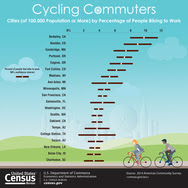
To commemorate Bike to Work Week (May 16-20) and Bike to Work Day (May 20), the U.S. Census Bureau presents a graphic showing the percentage of people biking to work in cities with a population of 100,000 or more. The percentages are derived from the 2014 American Community Survey. Internet address:<www.census.gov/library/visualizations/2016/comm/bike2work.html>.
.

Thursday, April 28, 2016

How the Other Fifth Lives

From the New York Times:

For years now, people have been talking about the insulated world of the top 1 percent of Americans, but the top 20 percent of the income distribution is also steadily separating itself — by geography and by education as well as by income.

This self-segregation of a privileged fifth of the population is changing the American social order and the American political system, creating a self-perpetuating class at the top, which is ever more difficult to break into.

In hard numbers, the percentage of families with children living in very affluent neighborhoods more than doubled between 1970 and 2012, from 6.6 percent to 15.7 percent.

At the same time, the percentage of families with children living in traditional middle class neighborhoods with median incomes between 80 and 125 percent of the surrounding metropolitan area fell from 64.7 percent in 1970 to 40.5 percent.

Wednesday, April 27, 2016

Federal Court Finds Amazon Liable for Billing Parents for Children’s Unauthorized In-App Charges

Court Will Decide Amount of Monetary Relief Amazon Owes in Coming Months

A federal judge has granted the Federal Trade Commission’s request for summary judgment in the agency’s lawsuit against Amazon, Inc., for billing consumers for unauthorized in-app charges incurred by children.

The judge’s order in the case finds that Amazon received many complaints from consumers about surprise in-app charges incurred by children, citing the fact that the company’s disclosures about the possibility of in-app charges within otherwise “free” apps were not sufficient to inform consumers about the charges.

“We are pleased the federal judge found Amazon liable for unfairly billing consumers for unauthorized in-app purchases by children,” said FTC Chairwoman Edith Ramirez. “We look forward to making a case for full refunds to consumers as a result of Amazon’s actions.”

The order calls for further representations from the FTC and Amazon regarding the precise amount of monetary relief Amazon owes consumers as a result of its unlawful practices. In addition, the order grants a partial summary judgment requested by Amazon regarding injunctive relief requested by the FTC in the case.

The FTC’s case against Amazon was first filed in July, 2014. The FTC reached settlements with Apple, Inc. and Google, Inc. related to unauthorized in-app charges incurred by children requiring the companies to fully refund consumers for such charges, resulting in refunds to consumers totaling over $50 million.

Tuesday, April 26, 2016

Characteristics of minimum wage workers, 2015

From the Bureau of Labor Statistics:

In 2015, 78.2 million workers age 16 and older in the United States were paid at hourly rates, representing 58.5 percent of all wage and salary workers. Among those paid by the hour, 870,000 workers earned exactly the prevailing federal minimum wage of $7.25 per hour. About 1.7 million had wages below the federal minimum. Together, these 2.6 million workers with wages at or below the federal minimum made up 3.3 percent of all hourly paid workers.

The percentage of hourly paid workers earning the prevailing federal minimum wage or less declined from 3.9 percent in 2014 to 3.3 percent in 2015. This remains well below the percentage of 13.4 recorded in 1979, when data for hourly-paid were first collected on a regular basis.

This report presents highlights and statistical tables describing workers who earned at or below the federal minimum wage in 2015. The data are obtained from the Current Population Survey (CPS), a national monthly survey of approximately 60,000 households conducted by the U.S. Census Bureau for the U.S. Bureau of Labor Statistics (BLS). Information on earnings is collected from one-fourth of the CPS sample each month.

The CPS does not include questions on whether workers are covered by the minimum wage provisions of the federal Fair Labor Standards Act (FLSA) or by individual state or local minimum wage laws. The estimates of workers paid at or below the federal minimum wage are based solely on the hourly wage they report, which does not include overtime pay, tips, or commissions.

Monday, April 25, 2016

Older Americans Month: May 2016

President Kennedy first celebrated older Americans by designating May 1963 as Senior Citizens Month. After a meeting with the National Council of Senior Citizens, Kennedy encouraged all Americans to pay tribute to older people across the country. Every President since has issued a formal proclamation during or before the month of May in support of older Americans. In 1980, President Jimmy Carter’s proclamation changed the name to Older Americans Month. This month continues to be a time to celebrate those 65 and older through ceremonies, events and public recognition.
46.2 million
The number of people who were 65 and older in the United States on July 1, 2014. This group accounted for 14.5 percent of the total population. The 65 and older population grew from 44.7 million in 2013. Source: 2014 Population Estimates <http://factfinder.census.gov/bkmk/table/1.0/en/PEP/2014/PEPAGESEX> <http://www.census.gov/newsroom/press-releases/2015/cb15-113.html>
98.2 million
Projected population of people 65 and older in 2060. People in this age group would comprise nearly one in four U.S. residents at that time. Of this number, 19.7 million would be 85 or older. Source: 2014 National Population Projections, Table 3 <http://www.census.gov/population/projections/data/national/2014/summarytables.html>
2.4 million
Projected number of baby boomers in 2060. At that time, the youngest baby boomers would be 96 years old. Source: Population Estimates and Projections <http://www.census.gov/prod/2014pubs/p25-1141.pdf>
2033
The year in which, for the first time, the population 65 and older would outnumber people younger than 18 in the U.S. Source: 2014 National Population Projections <http://www.census.gov/population/projections/data/national/2014.html>