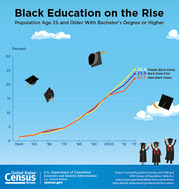
To commemorate and celebrate the contributions to our nation made by people of African descent, American historian Carter G. Woodson established Black History Week. The first celebration occurred on Feb. 12, 1926. For many years, the second week of February was set aside for this celebration to coincide with the birthdays of abolitionist/editor Frederick Douglass and Abraham Lincoln. In 1976, as part of the nation’s bicentennial, the week was expanded to a month. Since then, U.S. presidents have proclaimed February as National African-American History Month.
The following facts are made possible by the invaluable responses to the U.S. Census Bureau’s surveys. We appreciate the public’s cooperation as we continuously measure America’s people, places, and economy.
Note: The reference to the black population in this publication is to single-race black people (“black alone”) unless otherwise noted.
Did You Know?
The black population, either alone or in combination with one or more races, in the United States. Source: 2016 Population Estimates
The number of black military veterans in the United States nationwide. Source: 2016 American Community Survey
The percentage of the black population 16 and older working in management, business, science and arts occupations in 2016. Source: 2016 American Community Survey(Source includes more on occupations, commuting, and industries.)
Percentage of African-Americans completing high school. Source: 2016 Current Population Survey (Source includes more on education, including advanced degrees and school enrollment.)
The number of black-owned employer firm businesses in the United States in 2015. Source: 2015 Annual Survey of Entrepreneurs
More on Population Size
Voting Rates
Income, Poverty and Health Insurance
· Income
More Stats
See a detailed profile of the black population from the 2016 American Community Survey. Statistics include:
· Families and children
· Marital status
· Grandparents living with grandchildren
· Jobs
· Labor force participation
· Occupation
· Commuting
· Housing
Related News Products
Past Facts for Features
Stats for Stories
Releases
Graphics
|
Showing posts with label history. Show all posts
Showing posts with label history. Show all posts
Friday, February 2, 2018
Black) History Month: February 2018

Wednesday, August 26, 2015
Women's Equality Day
| In 1971, Congress passed a resolution making August 26, Women’s Equality Day, to celebrate the passage of the 19th Amendment in 1920 giving women the right to vote. This law grew out of the 1848 Seneca Falls Convention marking the start of the women’s rights movement. Leading the cause to get women equal voting rights were Elizabeth Cady Stanton and Susan B. Anthony. Anthony was the first woman to have her likeness on any type of U.S. currency - the silver dollar coin. Later this year, the Treasury Department will announce which woman will appear on the ten dollar bill starting in 2020, the 100th anniversary of the passage of the 19th Amendment. Learn more about women’s history and the Seneca Falls Convention. |
Tuesday, January 27, 2015
Black (African-American) History Month: February 2015
To commemorate and celebrate the contributions to our nation made by people of African descent, American historian Carter G. Woodson established Black History Week. The first celebration occurred on Feb. 12, 1926. For many years, the second week of February was set aside for this celebration to coincide with the birthdays of abolitionist/editor Frederick Douglass and Abraham Lincoln. In 1976, as part of the nation’s bicentennial, the week was expanded into Black History Month. Each year, U.S. presidents proclaim February as National African-American History Month.
Population
45.0 million
The number of blacks, either alone or in combination with one or more other races, on July 1, 2013,up 1.0 percent from July 1, 2012. Source: Population Estimates <http://factfinder2.census.
Wednesday, October 22, 2014
The State of Municipal Historians in New York
New York State requires every municipality to have a historian. This means every village, every town, every city, every county, and, of course, at the state level. Hamlets can ponder “should we or should we not have an historian, that is the question” but they are not legally obligated to have one. Nor are neighborhoods. That might seem self-evident outside New York City, but one should realize that the neighborhoods in the city can be substantially larger than even some cities.
Naturally, even when you are required to have a historian by state law there is no assistance from the state in support of that position. It is an unfunded mandate.
Let’s examine the state of these municipal historians.
- See more at New York History blog.
Naturally, even when you are required to have a historian by state law there is no assistance from the state in support of that position. It is an unfunded mandate.
Let’s examine the state of these municipal historians.
- See more at New York History blog.
Thursday, November 21, 2013
How can I get historical total population data?
If you have looked at the American FactFinder page from the Census Bureau but cannot find the population data you seek, because it's too old:
One source: The National Historical Geographic Information System (NHGIS) provides, free of charge, aggregate census data and GIS-compatible boundary files for the United States between 1790 and 2012.
Another source are the scanned copies of old Census publications. There may be more data in these reports than available through NHGIS, for smaller places.
One source: The National Historical Geographic Information System (NHGIS) provides, free of charge, aggregate census data and GIS-compatible boundary files for the United States between 1790 and 2012.
Another source are the scanned copies of old Census publications. There may be more data in these reports than available through NHGIS, for smaller places.
Tuesday, February 12, 2013
Abraham Lincoln Resources to Teach About Our 16th President
From humble roots to the leader of a nation during one of its most difficult times, Abraham Lincoln is one of the most respected and admired presidents. On his birthday, February 12, we recognize his contributions to our country.
16th President Abraham Lincoln, 1861-1865
Abraham Lincoln - An Extraordinary Life
Emancipation Proclamation, 1863
Gettysburg Address
Lincoln's Home
Lincoln Memorial
Activity: WebRangers Abraham Lincoln Review and Quiz
Lesson Plans: Lincoln Lesson Plans and Teacher Guides
Video: What Was in Lincoln's Pockets?
16th President Abraham Lincoln, 1861-1865
Abraham Lincoln - An Extraordinary Life
Emancipation Proclamation, 1863
Gettysburg Address
Lincoln's Home
Lincoln Memorial
Activity: WebRangers Abraham Lincoln Review and Quiz
Lesson Plans: Lincoln Lesson Plans and Teacher Guides
Video: What Was in Lincoln's Pockets?
Tuesday, June 5, 2012
1940s New York City - a seriously cool website
 Back in 1997, a copy of a 250-page document was purchased from a local bookstore. It was "NYC Market Analysis", published by four newspapers in 1943, "with photos, maps, data about each [city] neighborhood....it offers a unique window into New York [City] from another era.
"The Center for Urban Research at the CUNY Graduate Center is making the 1943 profiles available to provide context for the 1940 Census records and to offer a research aid to historians and anyone else interested in learning more about New York from the 1940s..."
The Welcome to 1940s New York website displays a map of New York divided into the 116 neighborhoods that are covered in the 1943 Market Analysis.
Monday's New York Times highlights the project along with some neat then-and-now photos and Census stats.
The Center for Urban Research at the CUNY Graduate Center website has more background, and Steven Romalewski, Director, CUNY Mapping Service, has blogged about the project.
I thank Steve for previewing this site at the State Data Center affiliates meeting last week.
Monday, March 26, 2012
Celebrate Women's History Month
Visit WomensHistoryMonth.gov to learn about generations of women who've made invaluable contributions to society.
You'll find:
Historical photos depicting women in the workforce from about 1916-1954.
An interactive game called Flight to Freedom that allows you to take on the role of Lucy, a 14-year-old slave in Kentucky in 1848.
A webcast of Annie Leibovitz's talk at the American Art Museum about her photo exhibition, Annie Leibovitz: Pilgrimage.
And more...
Sunday, August 21, 2011
"Keeping America Informed" U.S. Government Printing Office's 150th Anniversary History Exhibit
Did you know that the Government Printing Office is celebrating 150
years?
Here is a press release [PDF] on an exhibit with a URL to a YouTube video showing the GPO employees viewing the exhibit.
years?
Here is a press release [PDF] on an exhibit with a URL to a YouTube video showing the GPO employees viewing the exhibit.
Friday, September 24, 2010
NewYorkHeritage.org adds collections
New York Heritage Digital Collections has recently added twelve new collections to its cooperative site at newyorkheritage.org, including the Bowers Collection from the Broome County Historical Society, Historic Paintings Unwrapped from the History Center of Tompkins County, the Daughters of Charity Collection from the Lourdes Hospital, the Crandall Public Library Center for Folklife, History, and Cultural Programs Digital Collections, and the Digital Collections of Albany Law School.
NewYorkHeritage.org is a project of the NY 3Rs Association, which uses OCLC’s CONTENTdm Multisite Server to bring previously digitized collections together, allowing researchers to search across all items simultaneously. This project provides free, online access to images of cultural and historical significance in New York State.
Participants in New York Heritage Digital Collections are committed to enhancing the site by adding both content and contributing institutions on a regular basis. The goal of the project is to eventually connect one thousand collections and one million items from throughout New York State. All institutions interested in participating in the project are encouraged to complete this online form.
The New York 3Rs Association is a partnership among New York’s nine reference and research resource systems. The New York 3Rs was incorporated in 2003 to further the ability of those systems to provide statewide services. The members of the New York 3Rs Association are: the Capital District Library Council, Central New York Library Resources Council, Long Island Library Resources Council, Metropolitan New York Library Council, Northern New York Library Network, Rochester Regional Library Council, Southeastern New York Library Resources Council, South Central Regional Library Council, and Western New York Library Resources Council.
NewYorkHeritage.org is a project of the NY 3Rs Association, which uses OCLC’s CONTENTdm Multisite Server to bring previously digitized collections together, allowing researchers to search across all items simultaneously. This project provides free, online access to images of cultural and historical significance in New York State.
Participants in New York Heritage Digital Collections are committed to enhancing the site by adding both content and contributing institutions on a regular basis. The goal of the project is to eventually connect one thousand collections and one million items from throughout New York State. All institutions interested in participating in the project are encouraged to complete this online form.
The New York 3Rs Association is a partnership among New York’s nine reference and research resource systems. The New York 3Rs was incorporated in 2003 to further the ability of those systems to provide statewide services. The members of the New York 3Rs Association are: the Capital District Library Council, Central New York Library Resources Council, Long Island Library Resources Council, Metropolitan New York Library Council, Northern New York Library Network, Rochester Regional Library Council, Southeastern New York Library Resources Council, South Central Regional Library Council, and Western New York Library Resources Council.
Friday, August 27, 2010
Historical Population Data
Census of Population and Housing data present here ranges from our most recent census to the historical decennial census conducted throughout the decades. Some of the data were scanned as an effort to make historical census information available to the public. The display of data will continue as historical census records become available
Wednesday, August 25, 2010
Atlas of Historical County Boundaries
Data Detectives Ed and Michael have noted the Atlas of Historical County Boundaries, which "is meant to be a resource for people seeking records of past events, and people trying to analyze, interpret and display county-based historical data like returns of elections and censuses, and for people working on state and local history projects. The special interests of those potential users range from history to demography, economics, genealogy, geography, law, and politics."
The page features interactive maps of every county, extinct county, and unsuccessful county proposal from the creation of the first county through 31 December 2000; plus an index of counties and equivalents, with individual and statewide county chronologies. See how county boundaries changed over time.
The page features interactive maps of every county, extinct county, and unsuccessful county proposal from the creation of the first county through 31 December 2000; plus an index of counties and equivalents, with individual and statewide county chronologies. See how county boundaries changed over time.
Wednesday, June 2, 2010
Beloit College Mindset List for the entering college class of 2013
"This is the 12th year that Beloit College has assembled these observations that help to identify the experiences that have shaped the lives—and formed the mindset—of students starting their post-secondary education this fall.
"The Mindset List is not a chronological listing of things that happened in 1991, the year they were born. It is instead an effort to identify the worldview of 18 year-olds in the fall of 2009. Of course, our students come from many backgrounds and different traditions and these generalizations may not apply to all. The list identifies the experiences and event horizons of students and is not meant to reflect on their preparatory education.
"It is also not deliberately designed to make readers feel really old!"
Ah, but it DOES!
"The Mindset List is not a chronological listing of things that happened in 1991, the year they were born. It is instead an effort to identify the worldview of 18 year-olds in the fall of 2009. Of course, our students come from many backgrounds and different traditions and these generalizations may not apply to all. The list identifies the experiences and event horizons of students and is not meant to reflect on their preparatory education.
"It is also not deliberately designed to make readers feel really old!"
Ah, but it DOES!
Tuesday, March 23, 2010
Monday, March 22, 2010
Loss of 1890 Census data to fire: a genealogist’s nightmare
Of the decennial population census schedules, perhaps none might have been more critical to studies of immigration, industrialization, westward migration, and characteristics of the general population than the Eleventh Census of the United States, taken in June 1890. United States residents completed millions of detailed questionnaires, yet only a fragment of the general population schedules and an incomplete set of special schedules enumerating Union veterans and widows are available today.
Monday, March 15, 2010
9th Census (1870) Graphically
STATISTICAL ATLAS OF THE NINTH CENSUS (1870), published 1874

Presented here are all of the maps and charts from the first statistical atlas of the US Census, widely praised in its time and still a wonderful example of sophisticated graphics, the out-of-date racial/psychological nomenclature notwithstanding.
(Thanks to Dale.)

Presented here are all of the maps and charts from the first statistical atlas of the US Census, widely praised in its time and still a wonderful example of sophisticated graphics, the out-of-date racial/psychological nomenclature notwithstanding.
(Thanks to Dale.)
Thursday, February 25, 2010
Modern Mechanix blog

With the promise of "Yesterday's Tomorrows Today", the blog reprints futuristic technology stories that perhaps didn't quite come to pass.
London to Build Mid-City Air Port (Sep, 1931)
Outboard Motor Powers Bicycle (Jun, 1931)
Condon’s New Early Coreless Carrot (Feb, 1937)
Most of these stories were from Modern Mechanix itself, but some were from other publications. The latter piece is actually an advertisement from the pictured magazine.
Monday, September 29, 2008
You are Like a Hurricane
An online tool, Historical Hurricane Tracks, helps users get a quick picture of coastal areas with the greatest frequency of hurricanes and tropical storms -- and that historical "snapshot" can help community members and local emergency managers develop better plans for storm preparation and recovery.
NOAA Tracking Site Looks At Historical Hurricane Activity.
NOAA Tracking Site Looks At Historical Hurricane Activity.
Wednesday, February 20, 2008
Race: Are We So Different?
Data Detective Ed disccovered this web site:
Race: Are We So Different? - The project is full of census data, personal interviews, specialized bibliographies, quizzes, genetic data and a beautifully done interactive timeline on the race debate.
Race: Are We So Different? - The project is full of census data, personal interviews, specialized bibliographies, quizzes, genetic data and a beautifully done interactive timeline on the race debate.
Monday, January 28, 2008
Census/Popular Culture History
Lenny found this:
The Look-back blog "Modern Mechanix" has posted another scanned article on the Census from our near-past. This time it's an article from Popular Mechanics from April of 1960: Nose Count, 1960.
You may recall a similar article back in November. That one was from 1940.
There is also one from 1950.
The Look-back blog "Modern Mechanix" has posted another scanned article on the Census from our near-past. This time it's an article from Popular Mechanics from April of 1960: Nose Count, 1960.
You may recall a similar article back in November. That one was from 1940.
There is also one from 1950.
Subscribe to:
Posts (Atom)